Appetite for Risk: 7 Honest Decisions You Should Make Before Investing
Table Of Contents
Introduction
Before you invest, it is important to understand your appetite for risk. This refers to the level of investment risk you are willing and able to accept when markets move up and down. Some investors are comfortable with sharp price movements because they are focused on long-term growth. Others feel uneasy when their portfolio drops, even slightly.
There is no perfect appetite for risk that applies to everyone. A higher-risk investor is not automatically better, and a lower-risk investor is not automatically weaker. What matters is whether your investments match your financial goals, time horizon, income stability, and emotional comfort level. Your appetite for risk acts like a personal filter, helping you decide whether a higher-risk investment is suitable or whether a steadier approach may be more appropriate.
This is important because investing is not only about choosing products with attractive returns. It is also about choosing investments that you can realistically hold through different market conditions. If your portfolio is too risky for you, you may panic during a downturn and sell at the wrong time. If your portfolio is too conservative, it may not grow enough to support your long-term goals.
Understanding your appetite for risk before investing helps you make better decisions. It also helps you avoid copying someone else’s investment choices without knowing whether they suit you.
Lesson 1: Your Appetite for Risk Is Not Just About Returns
Many beginners think their appetite for risk is simply about how much return they want. They may say they want high returns, so they assume they should take high risk. But wanting higher returns and being able to handle higher risk are two different things.
Your appetite for risk is about how much uncertainty, volatility, and possible loss you can accept while staying calm and disciplined. It is easy to say you can take risks when markets are rising. The real test comes when your investment falls in value, and you have to decide whether to stay invested, review calmly, or panic.
For example, an investor may say they are comfortable with risk because they want their money to grow faster. But if a 10% drop makes them lose sleep, check their portfolio every hour, or feel the urge to sell everything, their actual appetite for risk may be lower than they thought.
This is why investors should be honest with themselves. Your appetite for risk is not about sounding brave. It is about knowing what level of market ups and downs you can realistically handle without making poor decisions.
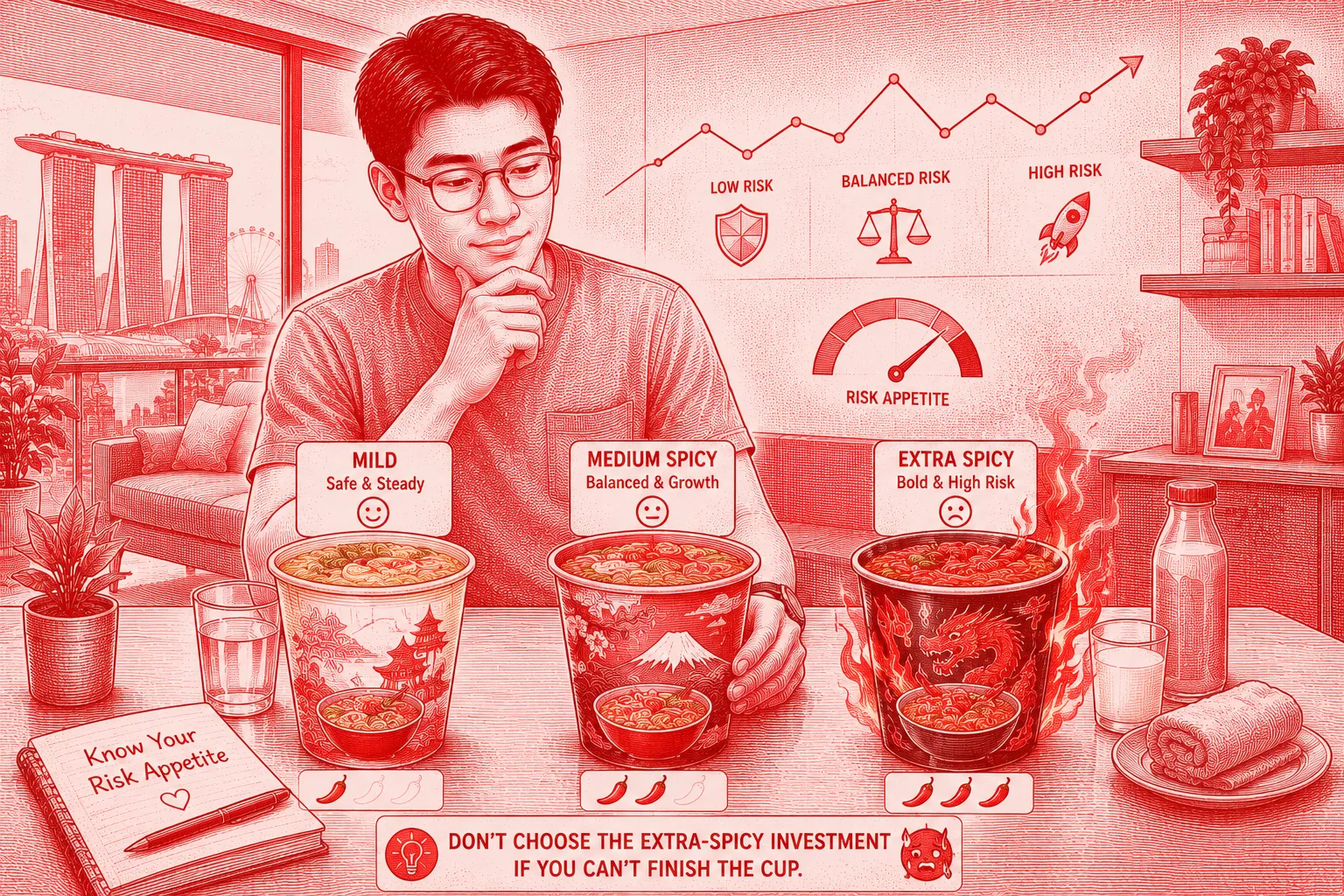
Lesson 2: The Cup Noodle Spice Level Makes It Easier to Understand
Imagine you are choosing cup noodles for supper.
One person picks the extra-spicy flavour without hesitation. Another chooses mild tom yum. Someone else goes for the chicken flavour because they know spicy food isn't for them. Nobody is wrong. They simply have different spice tolerance.
Your appetite for risk works in a similar way. Some investors are comfortable with larger market ups and downs because they have a longer time horizon, stable income, and the emotional resilience to stay calm during downturns. Others may feel anxious even when their investment drops slightly. For them, a more stable investment approach may be more suitable. This is why understanding your appetite for risk is important before investing, because it helps you choose an investment “spice level” that you can actually live with.
The mistake happens when someone with low spice tolerance orders the extra-spicy cup noodles just because their friend says it is good. At first, it may look exciting. But after a few mouthfuls, the heat arrives, the sweating begins, and regret starts doing push-ups.
In investing, this is like choosing a risky investment because someone else made money from it, without asking whether it suits you. It may look attractive when markets are doing well. But when prices fall, you may realise you cannot handle the volatility.
Your appetite for risk is not about being brave for the sake of it. It is about knowing how much investment “spice” you can realistically take without panicking, selling at the wrong time, or making decisions you later regret.
In simple terms, do not order the extra-spicy investment if you cannot finish the cup.
Lesson 3: Your Reaction to Market Drops Is an Important Sign
One of the clearest signs of your appetite for risk is how you react when markets fall. Market volatility is normal, but not every investor experiences it the same way. Some investors see downturns as part of the journey. Others feel anxious, frustrated, or afraid.
For example, imagine your investment portfolio falls by 10%. Would you remain calm and review your plan? Would you feel uncomfortable but still stay invested? Or would you want to sell everything immediately and move into cash? Your answer gives you clues about your real comfort with risk. A realistic appetite for risk should reflect how you behave during uncomfortable markets, not just how confident you feel when everything is going up.
The same applies to larger drops. A 20% or 30% fall can feel very different from a small decline. Many investors believe they can take risks until they experience an actual market downturn. Theory is easy. Seeing your own money fall is different.
This is why it is useful to consider potential losses before investing. If a certain level of decline would cause you to panic, that may be a sign that your portfolio is too aggressive for your appetite for risk.
A suitable investment portfolio should not only look good when markets are rising. It should also be something you can hold sensibly when markets are uncomfortable.
Lesson 4: Your Time Horizon Affects How Much Risk You Can Take
Your investment time horizon plays a major role in your appetite for risk. The longer you can stay invested, the more time you may have to ride through market ups and downs. The shorter your time horizon, the less room you may have to recover from a downturn.
For example, someone investing for retirement 25 years from now may be able to accept more short-term volatility. If markets fall, the portfolio still has many years to recover. On the other hand, someone who needs the money in two years for a home purchase, education expense, or major life event may need a more cautious approach.
This is because risk is not only about personality. It is also about timing. Even if you are emotionally comfortable with volatility, it may not be sensible to take too much risk with money you need soon. Your appetite for risk should therefore be considered together with your time horizon, because the same investment may be reasonable for long-term money but unsuitable for money you need soon.
Using the cup noodle analogy, if supper is in five minutes, you probably should not experiment with the mystery extra-spicy flavour. But if you are planning your pantry for the next few months, you may have more room to try different options.
In investing, the purpose of the money matters. Short-term money should usually be treated differently from long-term growth capital.
Lesson 5: Your Income Stability and Cash Buffer Matter
Your appetite for risk is also affected by your financial foundation. Someone with stable income, manageable expenses, and a proper emergency fund may be able to take on more investment risk than someone with unstable income, high commitments, or a limited cash buffer. This means your appetite for risk may change depending on how secure your cash flow feels at different stages of life.
This is because market downturns are harder to handle when your personal cash flow is already under pressure. If you lose income or face an unexpected expense, you may be forced to sell investments at a bad time. That can turn short-term market volatility into a real financial problem.
A cash buffer can help. It gives you breathing space so that you do not need to rely on your investments for every emergency. This can make it easier to stay invested during difficult periods.
In the cup noodle example, a cash buffer is like having a cup of water beside you when eating spicy noodles. The spice is still there, but at least you are not completely helpless when the heat kicks in.
For beginners, this is an important point. Before taking a higher investment risk, make sure your basic financial foundation is stable. Investing aggressively without enough emergency savings can be like ordering extra-spicy noodles with no water nearby. Very bold, but not always wise.
Lesson 6: Good Markets Can Mislead You About Your Risk Appetite
Many people only think about risk when markets fall. But your behaviour during good markets also reveals your appetite for risk.
When markets are rising, risky investments can look very attractive. Friends may talk about gains. Social media may highlight success stories. Some investors may start feeling that they are missing out. This can lead them to take more risk than they originally planned.
This is where beginners need to be careful. A rising market can make people overestimate their risk appetite. They may think they are comfortable with risk when they are actually only comfortable with gains. That is not the same thing.
For example, someone may invest aggressively after seeing others make money. But when the market later falls, they realise they were not prepared for the downside. The investment did not become unsuitable only after the drop. It may have been unsuitable from the start.
In cup noodle terms, this is like seeing everyone online praise an extra-spicy flavour and assuming you can handle it too. The photo looks nice. The review sounds exciting. But your stomach still has to deal with the actual spice.
Good markets can make risk look harmless. A clear understanding of your appetite for risk helps you avoid getting carried away.
Lesson 7: The Right Investment Should Match Your Comfort and Goals
The purpose of understanding your appetite for risk is not to avoid risk completely. Risk is part of investing. The goal is to take a level of risk that matches your goals, time horizon, financial situation, and emotional comfort.
For example, a young investor with long-term goals may choose a portfolio with more growth assets, such as equities or equity funds. This may involve more volatility, but it may also offer better long-term growth potential. A more conservative investor may prefer a portfolio with more bonds, cash, or lower-volatility options, even if the expected return is lower.
Neither approach is automatically right or wrong. The right approach depends on the person. A portfolio that is suitable for one investor may be too risky or too conservative for another.
This is why copying someone else’s portfolio can be dangerous. Your friend may have a different income, different family responsibilities, a different time horizon, a different knowledge level, and a different emotional response to losses. Their extra-spicy cup noodles may not be your supper.
A suitable investment plan should help you stay invested sensibly. It should not make you panic every time markets move. It should also not be overly conservative, as that would fail to support your long-term goals.
Understanding your appetite for risk helps you choose investments that you can live with, not just investments that look attractive on paper.
Conclusion
Your appetite for risk is one of the most important things to understand before investing. It affects how much volatility you can accept, what type of investments may suit you, and whether you can stay calm when markets move against you.
The key signs include how you react to market drops, how long you can stay invested, how stable your income is, whether you have enough cash buffer, and how you behave when markets are doing well. These signs reveal your true comfort with market ups and downs.
For beginners in Singapore, the cup noodle spice level is a simple way to remember the idea. Some people can handle extra spicy. Some prefer mild. Some should not pretend they enjoy spice just because their friend says it is good.
Investing works the same way. Do not choose a high-risk investment just because it looks exciting or someone else made money from it. Choose investments that align with your goals, time horizon, and your comfort with risk.
In simple terms, understand your appetite for risk before investing. Because when the market gets spicy, you need to know whether you can really finish the cup.
Frequently Asked Questions
Appetite for risk is the level of investment risk you are willing and able to accept in pursuit of your financial goals. It reflects both your emotional comfort with market fluctuations and your financial ability to withstand losses.
No. A higher appetite for risk does not automatically lead to better financial outcomes. The most suitable investment strategy is one that matches your financial goals, investment horizon and ability to tolerate market volatility.
Yes. Your appetite for risk may change as your financial situation, age, family responsibilities or investment experience changes. It is a good idea to review your investment strategy periodically.
Consider questions such as:
- How would you react if your investments fell by 20%?
- When will you need the money?
- Do you have an emergency fund?
- Can you tolerate temporary losses without changing your investment plan?
Appetite for risk refers to your willingness to take investment risk, while risk capacity refers to your financial ability to absorb losses. A suitable investment strategy should consider both.
Yes. A lower appetite for risk does not mean you should avoid investing altogether. Instead, you may choose investments with lower volatility or allocate more of your portfolio to lower-risk asset classes.
Not necessarily. Younger investors often have a longer investment horizon, but their investment decisions should still reflect their financial goals, income stability and personal comfort with market fluctuations.
Review your appetite for risk whenever there is a major life event, such as getting married, having children, changing jobs, approaching retirement or experiencing significant changes in your financial situation.
If your investments are riskier than you are comfortable with, you may panic during market downturns and sell at the wrong time. Matching your investments to your appetite for risk helps you stay disciplined over the long term.
Yes. Your appetite for risk does not have to be the same for every financial goal. For example, you may have a higher appetite for risk when investing for retirement over the next 30 years, but a lower appetite for risk when saving for your child’s university fees in five years. Matching your investment risk to each financial goal can help you balance growth opportunities with financial security.