ACP Singapore: Advance Care Planning Before a Medical Crisis
Table Of Contents
Introduction
Many Singaporeans spend years planning for their future. They buy insurance, save for retirement, write wills, and nominate beneficiaries for their CPF savings and insurance policies. Yet, one important part of planning is often overlooked—what happens if you are still alive but become unable to communicate because of a serious illness, accident, or loss of mental capacity?
This is where ACP Singapore, or Advance Care Planning, becomes an important part of protecting yourself and your loved ones. While financial planning focuses on your money and assets, Advance Care Planning focuses on your future healthcare wishes. It gives you an opportunity to think about the type of care you would want, discuss your preferences with the people closest to you, and help your healthcare team understand what matters most if you are no longer able to speak for yourself.
Many people mistakenly believe ACP Singapore is only for elderly individuals or patients with terminal illnesses. In reality, a medical crisis can happen unexpectedly at any age. A serious accident, stroke, or sudden illness may leave you temporarily or permanently unable to make healthcare decisions. Without prior discussions, your family may be left guessing what you would have wanted during one of the most stressful periods of their lives.
Advance Care Planning differs from other legal planning tools. It does not replace a Lasting Power of Attorney (LPA), which appoints someone to make decisions on your behalf if you lose mental capacity. Neither is it the same as an Advance Medical Directive (AMD), which addresses extraordinary life-sustaining treatment under limited circumstances. Instead, ACP Singapore complements these arrangements by helping your loved ones and healthcare professionals understand your values, priorities, and preferences before a medical crisis occurs.
Ultimately, ACP Singapore is about giving your family guidance rather than difficult guesses. It encourages meaningful conversations before they become urgent decisions and helps ensure that future healthcare choices reflect what is important to you.
Before you assume Advance Care Planning is only about end-of-life care, here are 7 important things every Singaporean should know about ACP Singapore.
Decision 1: Understand What ACP Singapore Really Means
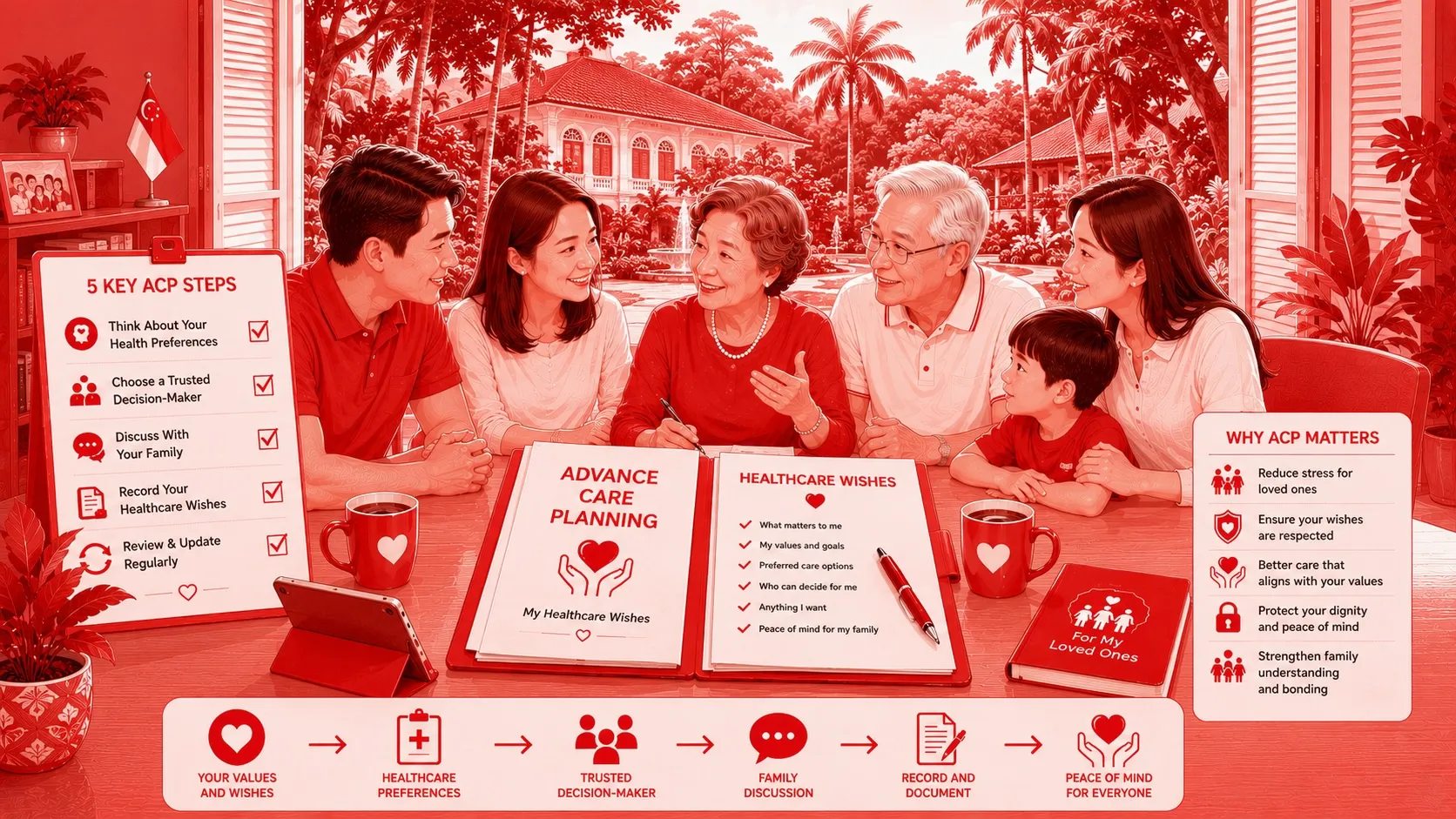
One of the biggest misconceptions about ACP Singapore is that it is simply another legal document that you complete and file away. In reality, Advance Care Planning is first and foremost a conversation. While written records may form part of the process, the real purpose of ACP is to help the people around you understand your healthcare wishes before a medical crisis happens.
Advance Care Planning allows you to think about what matters most if you become seriously ill and cannot communicate. Rather than asking doctors or family members to guess your preferences, ACP gives you the opportunity to explain your values while you are still able to make informed decisions.
Imagine you are involved in a serious accident and become unconscious. Your doctors may need to make urgent treatment decisions, while your spouse or children are asked questions they have never discussed with you before. Would you want every reasonable treatment attempted? Would you prefer care that focuses on comfort if recovery is unlikely? Would you rather receive care at home if it is medically appropriate? These are deeply personal questions, and different people may have very different answers.
Without ACP, your loved ones may each believe they know what you would have wanted. Unfortunately, those views may not always align. One family member may want doctors to continue every possible treatment, while another believes you would have prioritised comfort and quality of life. Such disagreements can place enormous emotional strain on families at an already difficult time.
ACP Singapore helps reduce this uncertainty. It does not attempt to predict every possible medical situation, nor does it provide instructions for every healthcare decision. Instead, Advance Care Planning helps communicate your values, priorities, and overall goals for future care so that doctors and your loved ones can make decisions that are consistent with your wishes.
Another common misunderstanding is that ACP is only relevant near the end of life. This is not true. A person may temporarily lose the ability to communicate because of an accident, surgery, severe infection, or stroke, yet later recover. In these situations, Advance Care Planning still provides valuable guidance during the period when the person cannot speak for themselves.
In simple terms, ACP Singapore is not about planning for death. It is about planning for uncertainty while you are still alive. The earlier these conversations take place, the easier it is for everyone involved to understand your wishes without the pressure of an emergency.
Decision 2: Know Why ACP Singapore Matters Before a Medical Crisis
Most families rarely talk about serious illness until they are forced to. Conversations about future healthcare, life support, or personal wishes can feel uncomfortable, especially in Singapore, where discussing illness or death is often seen as sensitive. Many people assume there will always be time to have the conversation later.
Unfortunately, medical emergencies rarely give families that opportunity.
A sudden stroke, heart attack, major accident, or unexpected illness can change everything within hours. During these situations, family members may suddenly find themselves sitting with doctors, trying to make decisions without knowing what their loved one would actually want.
This is exactly why ACP Singapore encourages conversations before a crisis occurs. By discussing your wishes while everyone is calm, healthy, and able to think clearly, you reduce the emotional burden your family may experience later.
Imagine a husband and wife who have never discussed future healthcare decisions. If one spouse suddenly loses the ability to communicate, the other may struggle with questions such as whether to continue aggressive treatment, whether home care would have been preferred, or how much medical intervention would be appropriate if recovery appears unlikely. Even siblings may disagree because each person interprets the patient’s wishes differently.
Advance Care Planning cannot eliminate every difficult decision, but it provides something equally valuable: clarity. When your loved ones understand your values beforehand, they are less likely to wonder whether they are making the “right” decision. Instead, they can focus on making decisions that are consistent with what you have already shared.
ACP Singapore also benefits healthcare professionals. Doctors and nurses are trained to provide medical advice, but they cannot know your personal beliefs, cultural values, or family priorities unless you tell them. Advance Care Planning bridges that gap by giving healthcare teams better insight into what matters most to you as an individual.
Some people worry that discussing ACP Singapore means expecting the worst. In reality, many families find the opposite to be true. Having these conversations often brings reassurance because everyone understands each other’s wishes before a crisis occurs. Instead of avoiding an uncomfortable topic, they gain greater confidence that future decisions will respect the person’s preferences.
Ultimately, ACP Singapore is not about preparing for death. It is about preparing for life’s uncertainties. A thoughtful conversation today can prevent confusion, disagreement, and emotional distress tomorrow.
Decision 3: Understand the Difference Between ACP Singapore and a Lasting Power of Attorney
One of the most common questions Singaporeans ask is whether ACP Singapore is the same as a Lasting Power of Attorney. Although both involve planning for situations where you may no longer be able to make decisions, they serve very different purposes.
A Lasting Power of Attorney is a legal document that allows you to appoint one or more trusted individuals, known as donees, to make decisions on your behalf if you lose mental capacity. Depending on the powers granted, your donee may make decisions relating to your personal welfare, property, and financial affairs.
Advance Care Planning is different. Rather than appointing someone to make decisions, ACP focuses on helping others understand the healthcare decisions you would want them to consider. It records your values, priorities, and preferences so that your loved ones and healthcare professionals have meaningful guidance if you are unable to communicate.
A useful way to remember the difference is this:
- An LPA answers the question, “Who can decide for me?”
- Advance Care Planning answers the question, “What would I want?”
These two planning tools work best when used together. Your LPA donee may have legal authority to make decisions on your behalf, but Advance Care Planning gives that person valuable insight into your wishes. Without those conversations, even someone you trust deeply may still struggle to know what decision you would have preferred.
Many Singaporeans complete an LPA without discussing their healthcare values with their appointed donees. Others have detailed conversations but never formally appoint someone to make decisions if they lose mental capacity. Both situations leave an important gap.
Rather than choosing between the two, it is often better to see ACP Singapore and an LPA as complementary parts of a complete personal planning strategy. One provides legal authority, while the other provides personal guidance. Together, they help ensure that future healthcare decisions are not only legally valid but also aligned with your wishes.
Decision 4: Understand the Difference Between ACP Singapore and an Advance Medical Directive
Another area of confusion is the difference between ACP Singapore and an Advance Medical Directive (AMD). Although both relate to future healthcare decisions, they serve different purposes and should not be used interchangeably.
An Advance Medical Directive is a legal document that states you do not wish to receive extraordinary life-sustaining treatment if you become terminally ill, unconscious, and death is imminent. It applies only in very specific medical circumstances defined under Singapore law.
Advance Care Planning is much broader. Instead of focusing on a single medical situation, ACP encourages discussions of your overall healthcare values and preferences. These conversations may include your thoughts on quality of life, comfort care, preferred place of care, cultural or religious beliefs, family involvement, and the type of medical treatment that reflects your personal values.
A simple comparison helps illustrate the difference.
An AMD is a legal instruction about one specific type of medical treatment under very limited circumstances.
Advance Care Planning is an ongoing conversation that helps guide a much wider range of healthcare decisions throughout your life.
Because the two serve different purposes, having one does not automatically replace the other. A person may complete an AMD while also participating in Advance Care Planning. Likewise, someone who has had detailed ACP conversations may still decide that making an AMD is appropriate for their own circumstances.
For many Singaporeans, ACP Singapore is often the more natural starting point because it begins with conversations rather than legal paperwork. Once you have reflected on your values and discussed them with your loved ones, you may then decide whether additional planning tools, such as an LPA or AMD, are appropriate for your situation.
Decision 5: Decide Who Should Consider Advance Care Planning
A common misconception is that Advance Care Planning is only relevant for elderly people or those living with serious medical conditions. While these groups may benefit greatly from ACP, the reality is that no one can predict when a medical crisis might occur. A serious accident, stroke, sudden illness, or unexpected medical complication can affect anyone, regardless of age.
This is why ACP Singapore encourages people to start the conversation early rather than waiting until a health problem arises. When you are healthy and able to think clearly, you are in the best position to reflect on your values and communicate your wishes without pressure or urgency.
Advance Care Planning may be particularly valuable if you are married, have children, care for ageing parents, have a chronic medical condition, or simply want your loved ones to understand your healthcare preferences. It is also worth considering if you have already made a Lasting Power of Attorney, as ACP provides your appointed donee with valuable guidance about the healthcare decisions you would want them to consider.
Young adults should not dismiss ACP simply because they feel healthy. Although younger people generally have a lower risk of serious illness, unexpected accidents and medical emergencies can happen without warning. Having an ACP conversation does not mean expecting something bad to happen. Instead, it means making sure your loved ones understand your wishes in the event of the unexpected.
For older adults, Advance Care Planning becomes even more important as health conditions become more complex. Discussing healthcare preferences while you are still able to communicate clearly allows your family to understand your wishes directly from you, rather than later trying to interpret them.
Singles should also consider ACP. Without a spouse or children, it is even more important to identify who should understand your healthcare wishes. This may be a sibling, another relative, or a trusted friend who knows you well and is willing to communicate your preferences to healthcare professionals if needed.
Ultimately, ACP is not about age. It is about making life easier for the people who care about you. If someone may one day need to speak on your behalf, it makes sense for them to understand what matters most to you.
Decision 6: Know What to Discuss During Advance Care Planning
Many people assume that Advance Care Planning is simply about deciding whether they want certain medical treatments. In reality, ACP is much broader. It is an opportunity to discuss the values and beliefs that should guide future healthcare decisions rather than trying to predict every possible medical scenario.
A good ACP conversation often begins with simple questions instead of complicated medical discussions. What gives your life meaning? What quality of life is important to you? Are there situations where comfort would matter more than extending life? Would you prefer to receive care at home if possible, or would you feel more comfortable in a hospital setting? These questions help your loved ones understand your priorities, rather than focusing only on specific treatments.
Advance Care Planning also encourages you to think about the people who may be involved in future healthcare decisions. Is there someone you trust to communicate with doctors on your behalf? Have you discussed your wishes with your spouse, children, or other close family members? If different family members hold different opinions, have you explained why certain preferences are important to you?
Some conversations may involve personal beliefs rather than medical choices. Religious faith, cultural traditions, family responsibilities, and personal experiences can all influence how someone views serious illness and healthcare decisions. Sharing these beliefs helps your loved ones understand not only what you prefer, but also why those preferences matter to you.
For example, one person may say, “If my doctors believe there is a reasonable chance of recovery, I would like them to continue treatment.” Another person may feel differently and say, “If there is little chance of meaningful recovery, I would rather focus on comfort and spending time with my family.” Neither answer is right nor wrong. Advance Care Planning exists because individuals value different things.
It is also important to remember that ACP is not a one-time discussion. Your priorities may change over time as your health, family circumstances, or life experiences change. Someone who is single today may later get married or have children. Someone who is healthy today may develop a chronic medical condition years later. Reviewing your ACP from time to time ensures it continues to reflect your wishes.
The purpose of Advance Care Planning is not to create a perfect plan for every situation. It is to give your loved ones enough guidance so they can make future healthcare decisions with greater confidence and peace of mind.
Decision 7: Know How to Start ACP Singapore
Many people delay ACP Singapore because they believe it involves complicated legal documents or difficult medical decisions. In reality, the first step is often much simpler than expected. It begins with a conversation.
You might start by saying to your family, “I’ve been thinking about what I would want if I became seriously ill one day.” Another approach is to ask your parents or spouse, “Have you ever thought about what kind of healthcare decisions you would want us to make if you couldn’t speak for yourself?” Questions like these open the door to meaningful conversations without making them feel overwhelming.
The first discussion does not need to cover every possible situation. In fact, it is often better to start with your values rather than specific treatments. Talking about what quality of life means to you, what you hope your family would understand, and what concerns you most about serious illness provides a strong foundation for future conversations.
In Singapore, there are also formal avenues for completing Advance Care Planning. Healthcare institutions, community organisations, and trained ACP facilitators can guide individuals and families through the process.
If you are helping an elderly parent start Advance Care Planning, try to approach the conversation with empathy rather than urgency. Instead of focusing on illness or death, explain that you simply want to understand their wishes so the family will know how to support them if something unexpected happens. Most parents appreciate knowing that their children are trying to respect their preferences rather than making assumptions.
The most important thing is not to wait until a crisis occurs. Once someone has lost the ability to communicate, opportunities to understand their wishes may already have passed. Starting ACP early allows everyone to think clearly, ask questions, and have open discussions without the pressure of an emergency.
Like many aspects of financial and estate planning, Advance Care Planning works best when done before it becomes necessary.
Common Mistakes Singaporeans Make About Advance Care Planning
One of the most common mistakes is believing that Advance Care Planning is only for people nearing the end of life. This misunderstanding prevents many healthy adults from having conversations that could one day help their families. The reality is that ACP is relevant to anyone who wants their healthcare wishes to be understood if they are unable to communicate.
Another mistake is assuming that family members automatically know what you would want. Although your spouse, children, or siblings may know you well, they may still have very different opinions when faced with difficult medical decisions. Without prior conversations, disagreements can arise simply because everyone is trying to do what they believe is best.
Some people also think ACP replaces a Lasting Power of Attorney or an Advance Medical Directive. These planning tools serve different purposes. Advance Care Planning explains your healthcare wishes, an LPA appoints someone to make decisions if you lose mental capacity, and an AMD provides legal instructions about extraordinary life-sustaining treatment under specific circumstances. They complement one another rather than replace each other.
Another common mistake is postponing the conversation until health problems develop. Unfortunately, a medical crisis may occur before those discussions ever happen. Starting ACP while you are healthy allows you to communicate your wishes clearly and gives your family greater confidence if difficult decisions become necessary in the future.
Finally, many families avoid Advance Care Planning because they worry the conversation will be upsetting. In practice, many people discover the opposite. Once the discussion begins, it often brings reassurance because everyone understands each other’s wishes more clearly. Instead of creating anxiety, ACP frequently reduces uncertainty and strengthens family communication.
How Advance Care Planning Fits Into Your Complete Legacy Planning
Many people associate legacy planning with writing a will, making CPF nominations, or deciding how assets should be distributed after death. While these are all important, they address only part of the overall picture. Good planning should also consider what happens if you are alive but unable to make or communicate healthcare decisions.
This is why ACP Singapore deserves a place alongside the other important planning tools available to Singaporeans. Each one serves a different purpose, and together they provide a more complete framework for protecting yourself and your family.
| Planning Tool | Main Purpose |
|---|---|
| Advance Care Planning (ACP) | Explains your healthcare wishes and future care preferences. |
| Lasting Power of Attorney (LPA) | Appoints someone to make decisions if you lose mental capacity. |
| Advance Medical Directive (AMD) | States your wishes regarding extraordinary life-sustaining treatment under specific circumstances. |
| Will | Specifies how your assets should be distributed after your death. |
| Trust | Manages and protects assets for beneficiaries according to your wishes. |
| CPF Nomination | Specifies who should receive your CPF savings. |
| Insurance Nomination | Specifies who should receive your insurance policy proceeds. |
| Grant of Probate / Letter of Administration | Gives legal authority to administer a deceased person’s estate. |
Viewed together, these planning tools tell a complete story. Advance Care Planning helps guide healthcare decisions while you are alive but unable to communicate. An LPA identifies who can make decisions on your behalf if you lose mental capacity. A will, trust, CPF nomination, and insurance nomination deal with what happens after your death, while probate or letters of administration allow your estate to be legally administered.
Rather than seeing these as separate documents, it is more helpful to think of them as different pieces of the same puzzle. Together, they help ensure that your wishes are understood, your loved ones have clearer guidance, and unnecessary uncertainty is reduced during difficult times.
Final Thoughts
Most people hope they will never need Advance Care Planning, just as they hope they will never need to claim on their insurance or rely on their emergency savings. However, planning is not about expecting the worst. It is about being prepared if life does not go according to plan.
ACP Singapore gives you the opportunity to share your healthcare wishes before a medical crisis occurs. It allows your loved ones to understand your values, supports healthcare professionals in making decisions that reflect your preferences, and reduces the emotional burden placed on your family during difficult times.
You do not need to have every answer today, nor do you need to make every decision immediately. The most important step is simply to begin the conversation. By talking openly about your values and healthcare wishes while you are still able to do so, you give your family something far more valuable than instructions—you give them confidence that they are respecting the choices you would have made for yourself.
For many Singaporeans, ACP Singapore may be one of the most meaningful conversations they have ever had. It is not simply about planning for a medical crisis. It is about protecting the people you love by helping them understand what matters most to you.
Frequently Asked Questions
Advance Care Planning (ACP) is a voluntary process that allows you to discuss and document your healthcare preferences in case you become unable to communicate your wishes in the future. It helps guide your loved ones and healthcare team when making medical decisions on your behalf.
Advance Care Planning is suitable for all adults, not just older people or those with serious illnesses. A sudden accident or unexpected medical condition can affect anyone’s ability to make healthcare decisions.
No. An Advance Care Planning document is not legally binding. However, healthcare professionals will generally take your documented wishes into account when making treatment decisions, together with your medical condition and discussions with your loved ones.
They serve different purposes:
- Advance Care Planning (ACP) records your healthcare preferences.
- Lasting Power of Attorney (LPA) appoints someone to make decisions if you lose mental capacity.
- Advance Medical Directive (AMD) instructs doctors not to use extraordinary life-sustaining treatment if you become terminally ill and meet the legal requirements.
Many people benefit from having all three as part of their overall care and estate planning.
Yes. You can review and update your Advance Care Planning document whenever your health, personal circumstances or healthcare preferences change.
You should discuss your wishes with your loved ones, your chosen spokesperson (if any) and your healthcare team. Open communication helps ensure your preferences are understood and respected if you cannot speak for yourself.
No. Advance Care Planning focuses on your healthcare preferences while you are alive. A will sets out how your assets should be distributed after your death. They serve different purposes and complement each other.
Healthcare professionals will consider your documented wishes together with your medical condition and the views of your loved ones. While ACP is not legally binding, it provides valuable guidance and helps your family understand what matters most to you.
No. Advance Care Planning covers a wide range of healthcare preferences, including your values, treatment goals and care preferences if you are unable to make decisions, not just end-of-life care.
You can begin by reflecting on your healthcare values and discussing them with your loved ones. If you are ready, you can arrange an ACP discussion with a trained facilitator through participating healthcare institutions.
Discussing your Advance Care Planning wishes helps your loved ones understand your healthcare preferences before a medical crisis occurs. It can reduce uncertainty, ease the emotional burden of making difficult decisions and provide reassurance that they are honouring your wishes if you are unable to communicate them yourself.