CPF Nomination and Insurance Nomination: 7 Important Differences Singaporeans Should Know
Table Of Contents
Intoduction
A CPF nomination is one of the most important legacy planning decisions a Singaporean can make. Yet many people delay doing it, forget to update it, or assume that their will automatically covers everything. That assumption can create problems.
In Singapore, your CPF savings do not form part of your estate and are not distributed according to your will. If you want your CPF savings to go to specific people, you need to make a CPF nomination. Without a CPF nomination, your CPF savings will be transferred to the Public Trustee’s Office for distribution according to Singapore’s intestacy laws, or the inheritance certificate for Muslims.
Insurance nomination works differently. It applies to eligible insurance policies, such as life or accident and health policies with death benefits, subject to the insurer's rules and Singapore’s nomination framework. Insurance nominations can also be revocable or trust nominations, and the consequences differ.
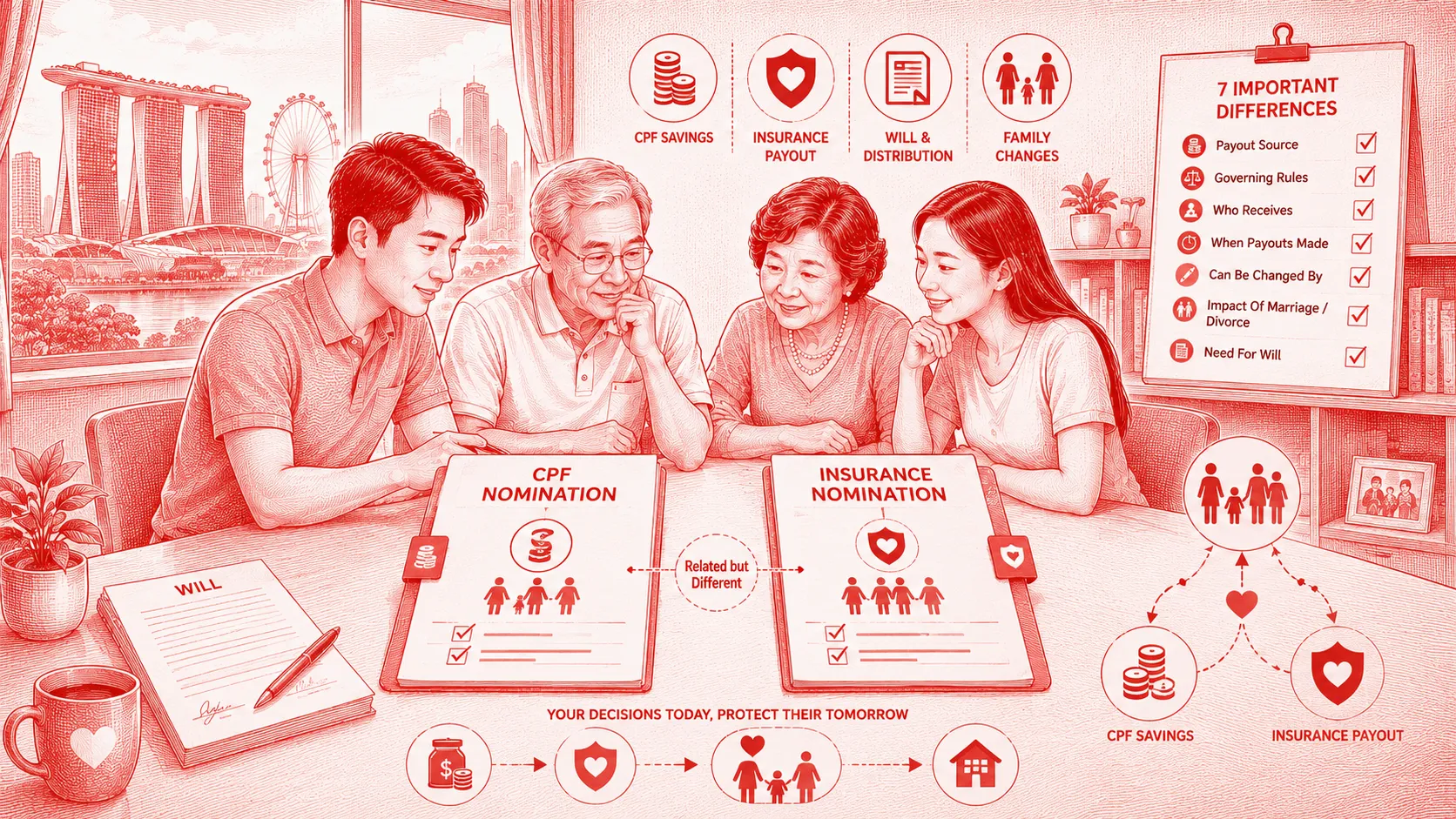
This is why CPF nomination and insurance nomination should not be treated as the same thing. Both help you decide who should receive money after you pass away, but they apply to different assets, follow different rules, and can affect your loved ones in different ways.
Here are 7 important differences Singaporeans should know.
1. CPF Nomination Covers CPF Savings, While Insurance Nomination Covers Insurance Policy Proceeds
The first difference is the scope of each nomination. A CPF nomination applies to your CPF savings, which generally include CPF savings left in your Ordinary Account, Special Account, MediSave Account and Retirement Account when you pass away.
Insurance nomination applies to eligible insurance policy proceeds. This usually means the death benefit from life insurance or accident and health insurance policies that allow nomination. Not every insurance policy can be nominated in the same way, so policyholders should check with their insurer or financial adviser.
In simple terms, a CPF nomination tells the CPF Board who should receive your CPF savings. An insurance nomination specifies who should receive the policy proceeds.
They are related to legacy planning, but they do not replace each other. If you have made an insurance nomination for your life insurance policy, that does not mean your CPF savings are covered. You still need a CPF nomination if you want your CPF funds distributed according to your wishes.
Likewise, if you have made a CPF nomination, it does not automatically decide who receives your life insurance payout. This is where many Singaporeans get confused. They may think, “I already nominated someone before,” but they may not remember whether it was for CPF, insurance, or both.
That small misunderstanding can become a big family problem later.
2. CPF Nomination Is Not Covered by Your Will
This is one of the most important points. Your CPF savings are not covered by your will. This means that even if you write a will, your CPF savings will not simply follow the instructions in your will.
For example, let’s say your will says, “All my assets are to be given equally to my spouse and children.” That may cover assets such as bank accounts, property, investments and personal belongings, depending on how your estate is structured. But it does not automatically cover your CPF savings.
Your CPF nomination is a separate instruction for your CPF savings.
Insurance nomination differs depending on the type of nomination and the policy structure. A revocable insurance nomination may generally be changed, and a valid will may affect it in some situations. However, a trust nomination is more serious because it creates a trust in favour of the nominated beneficiaries.
This is why legacy planning in Singapore should not be reduced to “just write a will.” A proper plan may involve CPF nomination, insurance nomination, a valid will, property ownership planning, guardianship planning for young children, Lasting Power of Attorney, and Advance Care Planning.
The CPF nomination is especially important because CPF is often one of the largest financial assets for many Singaporeans, especially after years of working, home ownership, and retirement savings.
3. If You Do Not Make a CPF Nomination, CPF Money Goes Through the Public Trustee
If you do not make a CPF nomination, your CPF savings do not simply go to whoever your family thinks is “obvious.” Instead, your CPF savings will be transferred to the Public Trustee’s Office. The Public Trustee will then distribute the money in accordance with Singapore’s intestacy laws or the inheritance certificate for Muslims.
This can lead to three practical issues. First, the distribution may not match your personal wishes. Second, the process may take more time because the legally entitled beneficiaries need to be identified. Third, fees may be charged for the Public Trustee’s distribution service.
This is why a CPF nomination is not just an administrative form. It is a practical way to reduce uncertainty for your family.
For example, you may want your CPF savings to go fully to your spouse because he or she depends on you financially. But if you have no CPF nomination, the distribution will be governed by the law, not necessarily your preferred arrangement. Or you may want to give some to your parents because they are elderly and depend on you. Again, without a CPF nomination, your wishes may not be carried out as intended.
A CPF nomination gives clearer instructions.
Insurance nomination also helps avoid uncertainty, but the process depends on the policy and the type of nomination. If there is no insurance nomination, the proceeds may be paid in accordance with the policy terms, the estate process, or applicable legal requirements.
The key point is this: if there is no CPF nomination, CPF follows the legal default route. No insurance nomination means the insurance payout is governed by the insurer’s policy rules and legal framework. Both situations can lead to delays or confusion if your instructions are unclear.
4. CPF Nomination Is Revoked by Marriage, But Not by Divorce
This is a detail many Singaporeans overlook. If you make a CPF nomination before marriage, your CPF nomination will be revoked when you get married. CPF explains that this happens because marriage creates a new family nucleus, and you should reconsider who you want to nominate.
If you made a CPF nomination when you were single and later married, you should make a new CPF nomination after marriage. Otherwise, you may mistakenly think your old CPF nomination is still valid.
Divorce is different. A CPF nomination is not automatically revoked upon divorce. This matters a lot. If you nominated your former spouse before the divorce and forgot to update your CPF nomination, that nomination may still remain valid after the divorce.
Insurance nominations also need to be reviewed after major life events, but the effect depends on the policy and nomination type.
The practical lesson is simple: after marriage, review your CPF nomination. After a divorce, review your CPF nomination. After having children, review your CPF nomination. After buying more insurance, review your insurance nomination. After the death of a nominee, review both.
Legacy planning is not a one-time “settle already” exercise. It is more like servicing your car. You do not need to check it every day, but if something major changes, please do not pretend the engine light is decorative.
5. CPF Nomination Is Usually Simpler, While Insurance Nomination Can Have Different Types
A CPF nomination is usually more straightforward. You decide who should receive your CPF savings and the percentage each nominee should receive.
Insurance nominations can be more complex because there are different types. In Singapore, policyowners can generally choose between a revocable nomination and a trust nomination, depending on the policy and circumstances.
A revocable nomination can generally be changed by the policy owner using Form 4. This gives flexibility if your family situation changes.
A trust nomination, made using Form 1, is more complicated. It creates a trust in favour of the nominees. Once made, the policyowner may lose some control over the policy, and changing it may require the consent of the beneficiaries or trustee, depending on the situation.
This is why insurance nomination should not be done casually.
For example, if you are a young parent and want to make sure a life insurance payout goes to your spouse and children, an insurance nomination may help make your intention clearer. But whether a revocable nomination or trust nomination is suitable depends on your objective.
Do you want flexibility? Do you want stronger protection for specific beneficiaries? Do you need to preserve control over the policy? Do you understand what rights you may be giving up?
A CPF nomination is important, but it typically does not involve the same level of product-specific complexity as an insurance nomination. With insurance nomination, the policy type, ownership, beneficiary choice and nomination type all matter.
6. CPF Nomination and Insurance Nomination May Affect Family Members Differently
A CPF nomination affects the distribution of your CPF savings. An insurance nomination affects how your insurance payout is distributed. But the emotional impact on your family can be very similar.
When someone passes away, family members are often grieving, confused, and under pressure. Clear nominations can help reduce unnecessary disputes.
For example, imagine a Singaporean with CPF savings, a HDB flat, a bank account, life insurance policies, no clear nomination records, and no will. In such a situation, the family may need to deal with the CPF Board, the Public Trustee, insurers, banks, lawyers, and possibly the courts. Each institution may have different procedures.
Now imagine the same person had a valid CPF nomination, proper insurance nominations, a valid will, clear records of policies and accounts, and a family conversation before anything happened. The financial assets may still take time to process, but the direction is much clearer.
This is the real value of properly doing a CPF nomination and insurance nomination. It is not just about money. It is about reducing stress for the people who have to handle matters when you are no longer around.
For families with young children, elderly parents, second marriages, blended families, or dependents with special needs, this becomes even more important. The “default arrangement” may not reflect your real family responsibilities.
The law does not automatically know who depends on you emotionally or financially. Your CPF nomination and insurance nomination help turn your intentions into clearer instructions.
7. CPF Nomination and Insurance Nomination Should Be Reviewed Together
Many people make their CPF nomination once and forget about it. Some buy insurance policies over the years but never check whether their nominations still make sense. That is risky.
Your CPF nomination and insurance nomination should be reviewed together as part of your overall legacy planning.
A good review should ask: Who are my current CPF nominees? Are the percentages still correct? Did I get married after making my CPF nomination? Did I divorce or separate after making my CPF nomination? Are any nominees no longer around? Do I have new dependants? Have I bought new insurance policies? Do my insurance policies have nominations? Are the nominations revocable or trust nominations? Does my will align with the rest of my planning?
This review is especially important at major life stages. You should consider reviewing your CPF nomination and insurance nomination when you get married, have children, get divorced, buy a property, start supporting elderly parents, buy new insurance, or approach retirement.
For Singaporeans, CPF is not a small side account. It may include retirement savings, housing-related balances, and MediSave savings built up over decades. Insurance can also be significant. A term insurance policy, a whole life policy, or a personal accident policy may pay out a meaningful amount to your family.
If your CPF nomination says one thing, your insurance nomination says another, and your will says something else, your family may face confusion later. The cleaner approach is to review everything together.
CPF Nomination vs Insurance Nomination: Simple Comparison
| Area | CPF Nomination | Insurance Nomination |
|---|---|---|
| What it covers | CPF savings | Eligible insurance policy proceeds |
| Covered by will? | No, CPF savings are not covered by a will | Depends on policy, nomination type and legal framework |
| If no nomination | CPF savings go to the Public Trustee for distribution according to intestacy laws or inheritance certificate for Muslims | Depends on insurer, policy terms and estate process |
| Revoked by marriage? | Yes, CPF nomination made before marriage is revoked | Depends on insurance nomination rules and policy structure |
| Revoked by divorce? | No, CPF nomination is not automatically revoked by divorce | Depends on nomination type and policy terms |
| Complexity | Usually simpler | Can be more complex due to revocable and trust nominations |
| Main purpose | Decide who receives CPF savings | Decide who receives insurance payout |
Common Mistakes Singaporeans Should Avoid
One common mistake is thinking that a will covers CPF savings. It does not. If you want your CPF savings to go to specific people, you need a CPF nomination.
Another mistake is making a CPF nomination before marriage and forgetting that marriage revokes it. After marriage, you should make a new CPF nomination if you want your CPF savings to be distributed according to your wishes.
A third mistake is assuming divorce automatically cancels your CPF nomination. It does not. If your former spouse is still your CPF nominee, you should review and update your CPF nomination if it no longer reflects your wishes.
A fourth mistake is treating insurance nomination as a simple form-filling exercise. A trust nomination can have serious consequences, so you should understand what you are signing before making one.
A fifth mistake is failing to tell your family where important documents are kept. Even if your nominations are properly done, your family should still know where to find your policy information, will, and important contacts.
Final Thoughts
A CPF nomination and an insurance nomination are both important, but they are not the same.
Your CPF nomination deals with your CPF savings. Your insurance nomination deals with your insurance policy proceeds. Your will deals with your estate. These are different tools, each with a different role in legacy planning.
For Singaporeans, the key lesson is simple: do not assume everything is covered just because you wrote a will. Do not assume your old CPF nomination is still valid after marriage. Do not assume divorce automatically updates your nomination. Do not assume your insurance nomination works the same way as your CPF nomination.
The better approach is to review your CPF nomination, insurance nomination, and will together.
Legacy planning is not only about what happens after you pass away. It is about making things clearer, faster, and less painful for the people you care about. A few careful decisions today can prevent a lot of confusion later.
Frequently Asked Questions
Yes. They serve different purposes. A CPF Nomination determines who receives your CPF savings after your death, while an Insurance Nomination determines who receives the proceeds of eligible insurance policies. Having one does not replace the other.
If you do not make a CPF Nomination, your CPF savings will be transferred to the Public Trustee’s Office for distribution according to Singapore’s intestacy laws, or the inheritance certificate for Muslims. This may not reflect your personal wishes.
No. Your CPF savings do not form part of your estate and are not distributed according to your will. A valid CPF Nomination takes precedence for the distribution of your CPF savings.
It depends on the type of insurance nomination. A Will cannot override an Irrevocable Nomination (Form 1).
A Will can change a Revocable Nomination (Form 4), but this is generally not recommended as it may lead to unnecessary delays or administrative complications. If you wish to change your beneficiaries, the simpler and more reliable approach is to submit a new nomination or revocation form directly to your insurer.
Yes. You can generally update or revoke your CPF Nomination and Insurance Nomination if your circumstances change, such as after marriage, divorce, the birth of a child or the death of a beneficiary.
Getting married automatically cancels your CPF nomination, but it does not cancel your insurance nomination.
No, getting a divorce does not automatically cancel either your CPF nomination or your insurance nomination.
Yes. You can generally nominate almost anyone you wish to receive your CPF savings or eligible insurance proceeds, including non-family members. If a nominee is below 18 years old, the proceed will usually be managed on their behalf by the appropriate legal representative or authority until they reach the age at which they can legally take control.
Not necessarily. Your CPF Nomination and Insurance Nomination can have different beneficiaries and different allocation percentages, depending on your financial goals and family circumstances. For example, you may wish to use your CPF savings to support your spouse while directing your insurance proceeds towards your children’s future needs. The most appropriate arrangement depends on your overall estate plan.