Integrated Shield Plan Cost in Retirement: What Singaporeans Should Prepare For
Table Of Contents
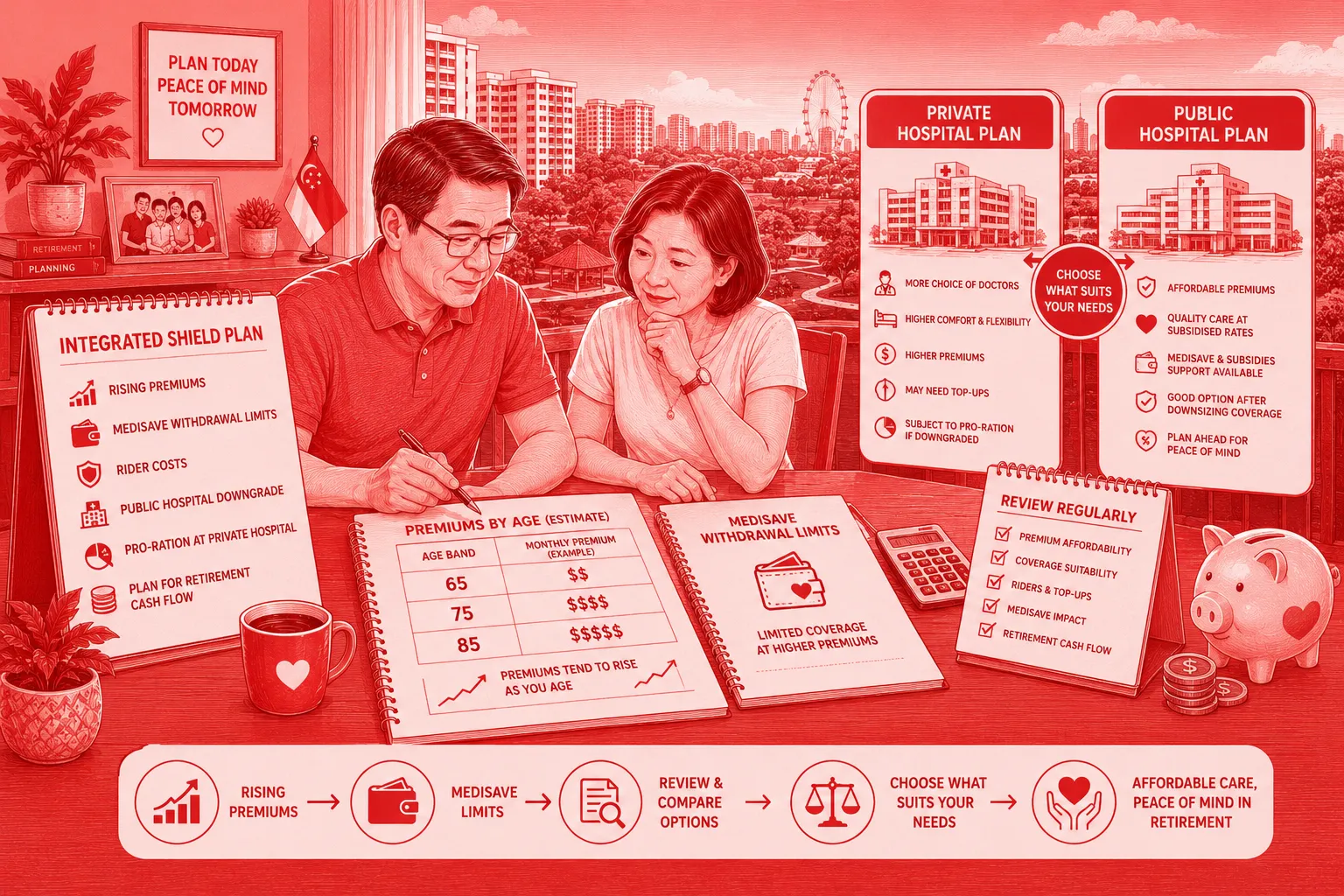
Introduction
An Integrated Shield Plan can be useful in retirement because it helps reduce the risk of large hospital bills. However, the plan itself also has a cost, and this cost often becomes more noticeable when a person stops working.
During working years, an Integrated Shield Plan premium may feel manageable because of regular salary, bonuses, and CPF contributions. In retirement, income may come mainly from CPF LIFE, savings, investments, rental income, or family support. At that stage, every recurring cost matters more, including healthcare insurance premiums.
This is why the question is not simply whether an Integrated Shield Plan is good or bad. The more practical question is whether the coverage remains suitable and affordable as you grow older. For many Singaporeans, the retirement review is not about removing hospital insurance completely, but about adjusting the plan so healthcare protection does not quietly drain retirement cash flow.
This article explains what Singaporeans should consider when reviewing the cost of an Integrated Shield Plan in retirement, including MediSave limits, private hospital plans, public hospital plans, riders, pro-ration, and downgrade decisions.
What an Integrated Shield Plan Does
An Integrated Shield Plan is a private hospitalisation insurance plan that works on top of MediShield Life. MediShield Life provides basic health insurance protection for Singapore Citizens and Permanent Residents, while an Integrated Shield Plan can provide additional private insurance coverage for higher ward classes or private hospital treatment.
Some plans are designed for private hospital coverage, while others are designed for treatment in public or restructured hospitals. Depending on the plan, the coverage may be pegged to private hospitals, public hospital A ward, public hospital B1 ward, or other ward classes.
There may also be an optional rider. The main plan helps pay eligible hospital bills in accordance with the policy terms, while the rider may help reduce out-of-pocket costs, such as the deductible and co-insurance, depending on the rider type and the rules that apply.
That is the short version. The focus of this article is not to explain every feature of an Integrated Shield Plan. The focus is on what happens when costs rise in retirement and what Singaporeans can realistically review before premiums become painful.
Why Cost Matters in Retirement
Medical costs are among the biggest drains on retirement funds. A major hospital bill can affect savings, family finances, and retirement confidence. This is one reason why many Singaporeans keep an Integrated Shield Plan even after they stop working.
At the same time, the plan is not free. Premiums usually increase with age because older policyholders are more likely to make healthcare claims. Riders can also become expensive at older ages. This creates a difficult retirement trade-off: you want protection against large medical bills, but you also need to manage the recurring cost of that protection.
For retirees, the problem is not only today’s premium. The problem is whether the premium remains affordable at age 65, 75, 85, or beyond. A plan that feels affordable at age 55 may feel very different after retirement income becomes fixed or less flexible.
This is why healthcare planning and retirement income planning should not be separated. The goal is not to keep the highest possible coverage at all costs. The goal is to keep suitable healthcare coverage without weakening retirement cash flow.
MediSave Limits
One important point many Singaporeans overlook is that MediSave does not necessarily pay the full Integrated Shield Plan premium. The premium has different parts, and each part may be treated differently.
MediShield Life premiums can be fully paid using MediSave. For the additional private insurance component of an Integrated Shield Plan, MediSave can be used only up to the Additional Withdrawal Limits. CPF states that the limits are based on age next birthday:
- $300 per year for ages 40 and below,
- $600 per year for ages 41 to 70, and
- $900 per year for ages 71 and above.
- Any amount above the applicable limit must be paid in cash.
This matters more in retirement because older policyholders may face higher premiums, while the MediSave withdrawal limit still caps the amount of the private insurance component that can be paid from MediSave. If the additional private insurance component exceeds the limit, the excess must be paid in cash.
Rider premiums are generally paid in cash and can increase with age. This means a retiree may be using MediSave for part of the Integrated Shield Plan premium, while still needing cash for amounts above the withdrawal limits and for rider premiums. When reviewing the plan, break the cost into two parts: what can be paid by MediSave, and what must be paid in cash.
Check the Premium Table
Before deciding whether to keep, downgrade, or adjust your Integrated Shield Plan, look at the premium table for the next few age bands. Do not review only this year’s premium.
A practical approach is to look at the next five years of premiums. For example, if you are 62, check what the premium may look like at 63, 64, 65, 66, and 67. This gives you a clearer view of whether the plan is still manageable after retirement income changes.
Some people also project their longer-term hospital insurance costs by adding up estimated premiums from age 65 to age 85 or 90. This is useful because one year’s premium does not show the full retirement commitment. However, the premium table does not guarantee that premiums will remain unchanged forever.
For planning purposes, it may be sensible to add a buffer of about 35% to 50% to the total projected premium amount. This is not a prediction, but a planning margin to account for possible future premium increases and medical inflation. If the plan already looks tight before adding this buffer, that is a signal to review your coverage early.
Downgrade to Public Hospital Plan
For many retirees, the biggest cost review is whether they still need a private hospital Integrated Shield Plan. Private hospital plans usually cost significantly more than public or restructured hospital plans, especially at older ages. If retirement cash flow is tight, this is often the first serious point of review.
Downgrading from a private hospital plan to a public or restructured hospital plan can reduce premiums. This does not mean the person is giving up good medical care. Singapore’s public healthcare system provides strong quality care, and many retirees may be comfortable receiving treatment in public or restructured hospitals.
The difference is often not “good care versus bad care”. That is too simplistic and not fair to the public healthcare system. The practical differences usually include waiting time, doctor choice, room comfort, convenience, and access to private hospital facilities. A person treated as a private patient in a public or restructured hospital can still receive good medical care.
The key is to review affordability before the cost becomes a crisis. Downgrading may be easier than upgrading later, since switching insurers or upgrading may involve underwriting. If your health has changed, a future upgrade or switching insurer may not be straightforward or may be subject to exclusions.
Private Hospital Claims After Downgrade
A common misunderstanding is that once someone downgrades from a private hospital plan to a public or restructured hospital plan, the plan will not pay anything if the person goes to a private hospital. This is not always true.
A public hospital plan may still provide some payout if the insured person chooses to receive treatment in a private hospital. However, pro-ration usually applies when treatment is received at a higher hospital type or ward class than the plan is designed to cover.
For example, suppose a retiree has a public hospital Integrated Shield Plan but later chooses to receive treatment in a private hospital. If the private hospital bill is $100,000 and the plan applies a 60% pro-ration factor to private hospital treatment, the claim may first be assessed at $60,000 rather than the full $100,000.
This means the eligible claim is reduced to $60,000 before other policy terms are applied. Deductible, co-insurance, rider terms, policy limits, exclusions, pre-authorisation rules, panel arrangements, and other conditions will then apply and reduce the final payout.
So the key message is simple: downgrading does not always mean zero cover in a private hospital, but the out-of-pocket risk will become much higher.
Downgrade to B Ward Plan
After downgrading from a private hospital plan, some retirees may still find the public hospital A ward plan expensive. In that case, a downgrade to a B1 or B ward plan may further reduce premiums.
However, not every insurer offers every ward-class option. Before planning a further downgrade, check whether your existing insurer offers the B1 or B ward option you want. Some people assume that every insurer has the same downgrade path, but the available options can differ.
If your existing insurer does not offer the ward-class option you want, switching to another insurer may not be simple. A new insurer may require underwriting, and any existing medical condition may affect whether you are accepted, whether exclusions apply, or whether the switch makes sense.
A further downgrade also involves trade-offs. Lower ward coverage may mean a different room setting, different entitlement, lesser doctor choice, and possibly higher out-of-pocket exposure if you later choose a higher ward or private hospital. The decision should not be made solely on the basis of the premium. Premium is important, but the retiree should also consider comfort with ward class, family preference, medical history, and expected use of public hospitals.
Keep the Plan, Drop the Rider
A lot of people assume that if they want to reduce hospital insurance costs, they must downgrade both the main Integrated Shield Plan and the rider. That is not the only option.
In some cases, a retiree may decide to keep the current main plan but give up the rider to reduce the cash premium. This may be especially relevant if the insurer does not offer a further downgrade option that meets the retiree’s needs, or if the retiree wants to keep the main hospital entitlement while reducing the recurring rider cost.
This approach has trade-offs. Without the rider, the retiree may need to pay more out of pocket, including a deductible and co-insurance, when making a claim. The cash premium may decline, but the potential claim-time cost may increase.
This is why the main plan and rider should be reviewed separately. The main plan affects the hospital or ward coverage level. The rider affects how much of the deductible and co-insurance may be reduced, subject to the rider terms and current rules.
Rider Rules Are Changing
A rider may help reduce out-of-pocket costs, such as deductibles and co-insurance, depending on the type of rider and when it was bought. However, riders are not as simple as “everything is covered”.
MOH announced in March 2018 that new Integrated Shield Plan riders must include a minimum 5% co-payment. This applies to new riders sold from 1 April 2019, while riders sold from 8 March 2018 to 31 March 2019 had to transition to these new co-payment riders by 1 April 2021.
From 1 April 2026, new IP riders sold will no longer be allowed to cover the minimum IP deductibles set by MOH. The co-payment cap will also be raised to a minimum of $6,000 per year, excluding the minimum IP deductible. There is no change to the minimum 5% co-payment requirement.
This means retirees and pre-retirees should be careful before changing riders. If you downgrade, switch, or replace a rider after the new requirements apply, the available replacement rider may follow the new structure and may not cover the minimum deductible. Existing rider treatment may depend on when the rider was bought and the insurer’s rules, so check carefully before making changes.
This is especially important for retirees considering downgrading their rider to lower premiums. A lower rider premium may look attractive, but the new rider may also require you to bear more costs during a claim.
What to Review Before Changing
Before changing your Integrated Shield Plan, review the current plan type. Are you covered for private hospital, public hospital A ward, B1 ward, or another ward class? This matters because the plan type affects both premium and claim treatment.
Next, check the premium table for the next five years. If the premium already looks difficult to sustain over the near term, do not ignore it. A planned downgrade is usually better than a rushed downgrade when the premium suddenly feels painful.
Also, check the longer-term cost. Some retirees may add up estimated premiums from age 65 to age 85 or 90 to understand the lifetime retirement commitment. Because premiums may rise over time, consider adding a 35% to 50% planning buffer to the projected total amount.
Then review the rider separately. What does it cover? How much does it cost today? How much might it cost at older ages? If you change the rider, will the new rider still cover the deductible, or will it follow the newer structure?
Finally, check whether your existing insurer offers the downgrade you want. If you need to switch insurers to get a certain option, underwriting may apply, and existing health conditions may complicate the decision.
Common Mistakes to Avoid
One common mistake is keeping a private hospital Integrated Shield Plan by default, even when retirement cash flow is tight. Some people continue with the same plan simply because they have always had it. That may be fine if it remains affordable, but it should be reviewed rather than assumed.
Another mistake is downgrading too late. If you wait until premiums become painful or health changes have already happened, your options may be more limited. Reviewing earlier gives you more room to make a calm decision.
A third mistake is downgrading without understanding pro-ration. A public hospital plan may still pay something if you go to a private hospital, but the claim may be pro-rated, and the out-of-pocket amount can be much higher.
A fourth mistake is assuming public hospital care means poor care. That is not a fair assumption in Singapore. The more practical question is whether you are comfortable with the waiting time, ward type, doctor choice, and overall care arrangement.
A fifth mistake is assuming riders cover everything. Newer riders require co-payment, and from 1 April 2026, new IP riders sold will no longer be allowed to cover the minimum IP deductibles set by MOH.
A sixth mistake is forgetting that MediSave has withdrawal limits for the additional private insurance component of an Integrated Shield Plan. The amount above the Additional Withdrawal Limit must be paid in cash, and rider premiums can add further cash cost.
A seventh mistake is looking only at this year’s premium. Retirees should review at least the next five years of premiums, and may also project the total cost from age 65 to 85 or 90 with a buffer for future premium increases.
Conclusion: Sustainable Coverage
An Integrated Shield Plan can be useful in retirement because medical bills can seriously affect retirement savings. However, the plan itself must also remain affordable. A healthcare plan that protects you from hospital bills but damages your retirement cash flow may still create stress.
For many Singaporeans, the key retirement review is whether to keep a private hospital plan, downgrade to a public hospital plan, further downgrade from A ward to B1 or B ward, adjust the rider, or keep the main plan while giving up the rider.
The aim is not automatically to keep the highest Integrated Shield Plan for life. The aim is to keep suitable coverage at a cost that remains sustainable as you age. That means looking at premiums, rider costs, MediSave limits, cash payments, pro-ration, ward class, rider changes, and your actual hospital preference.
Reviewing your Integrated Shield Plan before retirement gives you more options. Once health conditions change, upgrading or switching insurers may become harder. As with many retirement decisions, the better time to review is before you are forced to.
Frequently Asked Questions
It depends on your healthcare preferences, retirement income and ability to pay the premiums. Many retirees keep their Integrated Shield Plan but review whether the level of coverage remains affordable and appropriate for their retirement needs.
Yes. You can generally use MediSave to pay your Integrated Shield Plan premiums up to the prevailing Additional Withdrawal Limits (AWLs). If the premium exceeds the allowable MediSave amount, you will need to pay the difference in cash.
Downgrading may help reduce your premiums if maintaining private hospital coverage is no longer affordable. However, before making a decision, consider your healthcare preferences, expected retirement income and the potential impact on future claims.
You can generally still make a claim, but the payout is usually pro-rated to reflect the higher level of care, before any applicable deductible and co-insurance are applied. As a result, you may have to pay a significantly larger portion of the hospital bill yourself.
Generally, yes. Premiums typically increase with age because the likelihood of requiring medical treatment increases. This is one reason why reviewing the long-term affordability of your plan is important before retirement.
For many retirees, yes. An Integrated Shield Plan can help reduce the financial impact of major hospital bills. However, the level of coverage should remain affordable throughout retirement rather than placing unnecessary strain on your cash flow.
It depends on your budget and healthcare preferences. A rider can reduce your out-of-pocket costs when making a claim, but it also increases your annual premium. Review whether the additional cost remains worthwhile after you retire.
You may be able to upgrade later, but the upgrade is generally subject to medical underwriting. If your health has changed since you downgraded, your application may be declined or accepted with exclusions or premium loadings.
Consider:
- Your retirement income
- MediSave balances
- Long-term premium affordability
- Preferred hospital type
- Rider costs
- Potential future healthcare needs
Changing your plan should form part of your overall retirement planning rather than being based on premiums alone.
Cancelling your Integrated Shield Plan should generally be a last resort. While it eliminates future premiums, it also reduces your protection against large hospital bills. If affordability is a concern, consider whether downgrading your plan or reviewing your rider provides a better balance between healthcare protection and retirement cash flow before deciding to cancel altogether.