Will and Trust: 7 Important Decisions Before You Leave Money to Your Family
Table Of Contents
Introduction
Many Singaporeans know they should write a will, but fewer understand when a trust may be useful. This is why will and trust planning can be confusing. Both are used in legacy planning, both can affect how money is passed to loved ones, and both can help reduce family uncertainty. But they are not the same.
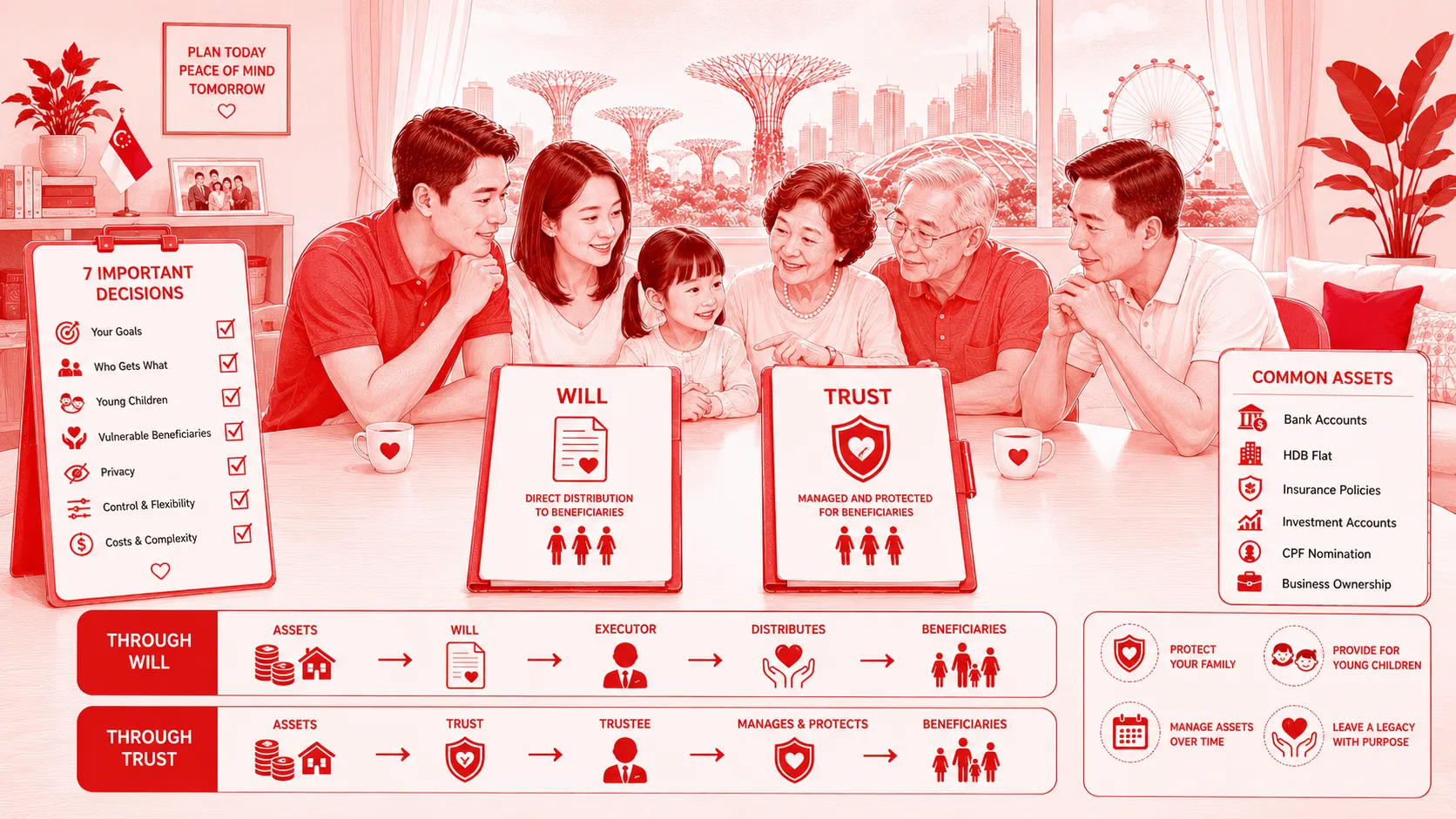
A will is a legal document that sets out how your money, property, and belongings should be distributed after your death. In Singapore, if you pass away without a will, your estate will generally be distributed according to the Intestate Succession Act for non-Muslims, or Muslim inheritance law for Muslims. That legal default may not match what you personally want.
A trust works differently. In simple terms, a trust is an arrangement where assets are held and managed by a trustee for the benefit of beneficiaries. A trust can be created during your lifetime or through your will after you pass away. Depending on its structure, a trust may help with asset management, control, privacy, young children, vulnerable beneficiaries, blended families, or more complex legacy planning needs.
The important point is this: will and trust planning is not about choosing the “rich people option” or the “simple option.” It is about choosing the right tool for the right purpose. For many Singaporeans, a will may be enough. For some families, a trust may add important protection and control. For others, both may be needed.
Here are 7 important decisions to consider before leaving money to your family.
1. Do You Only Need to Distribute Assets, or Do You Need Someone to Manage Them?
The first decision is whether your family only needs a clear distribution plan or whether someone needs to manage the money after you are gone.
A will is usually appropriate when your main goal is to decide who will receive your assets after your death. For example, you may want your spouse to receive your bank savings, your children to receive certain investments, or your beneficiaries to receive your share of a property. Your will can also appoint an executor to carry out your instructions and, where appropriate, name guardians for young children.
A trust may be useful when simply giving money directly is not the best solution. For example, if your child is still young, giving a large sum directly may not be practical. If a beneficiary is financially inexperienced, vulnerable, experiencing family problems, or has special needs, you may want the money managed carefully over time rather than paid out all at once.
This is where a trust can help. The trustee holds or manages the assets for the beneficiaries in accordance with the trust terms. Instead of giving everything immediately, the trust may provide money in stages, pay for education, cover living expenses, or protect assets for a specific purpose.
For example, a parent may leave money for a child’s university education but allow the child to receive the remaining amount only at a later age. Another parent may want to provide for a child with special needs without giving that child full control of the assets.
The key question is not “will or trust?” The better question is: Does my family need distribution, or does my family need ongoing management?
If your beneficiaries are adults, responsible, and your estate is straightforward, a will may be enough. If money needs to be managed for years, a trust may be worth considering.
2. Do You Want Your Assets Distributed Immediately, or Over Time?
The second decision is timing.
A will usually distributes assets after the estate administration process is completed. The executor identifies the assets, pays debts and expenses, applies for probate if needed, and distributes the estate according to the will. Once beneficiaries receive their inheritance, they usually control how they use it.
This may be perfectly fine if your beneficiaries are mature and financially stable. But it may not be ideal if you are leaving money to young children, beneficiaries who struggle with money, or family members who may be easily influenced by others.
A trust can allow more control over timing. Instead of distributing everything immediately, the trust can set out when and how beneficiaries receive money. For example, the trust may allow payments for education, medical needs, living expenses, or housing support. It may also provide staged distributions at certain ages or milestones.
This can be useful when you are worried that a beneficiary may spend the money too quickly, make poor decisions, or be exposed to pressure from others. It can also help when you want to support someone without giving them full access to the entire amount immediately.
For Singapore families, this can matter in real situations. A parent may want to leave money for children who are still in primary school. A retiree may want to provide for a spouse first, then children later. Someone in a second marriage may want to support the current spouse while preserving part of the estate for children from an earlier marriage.
A will can say who receives what. A trust can often give more detailed control over when and how the money is used. That timing difference is one of the biggest reasons people consider trust planning.
3. Are Your Beneficiaries Adults, Young Children, or Vulnerable Dependants?
The third decision is who your beneficiaries are.
If your beneficiaries are responsible adults, a will may be enough for many families. You state who gets what, appoint an executor, and make sure your estate is distributed according to your wishes.
But if your beneficiaries include young children, dependents with special needs, elderly parents, or financially vulnerable family members, will and trust planning becomes more important.
A young child cannot properly manage a large inheritance. Even if the money is meant for the child, an adult will need to manage it until the child is old enough. A will can appoint guardians and set out your wishes, but a trust may provide a more structured way to manage money for the child’s benefit.
A beneficiary with special needs may also require long-term financial support. In such cases, giving a lump sum directly may not be suitable. A trust may help provide ongoing care, living expenses, medical support, or other needs in a more controlled way.
For elderly parents, the issue may be different. They may not need a large lump sum, but may need regular support for daily expenses, medical care, or helper costs. A trust may help organise that support if there is enough money and the structure is appropriate.
The same applies to beneficiaries who may be going through bankruptcy, divorce, addiction, gambling issues, or serious financial instability. These are sensitive topics, but legacy planning should address real life, not idealised family-brochure life.
The more vulnerable your beneficiaries are, the more you should consider whether direct distribution is enough. A trust may not always be necessary, but the question should be asked.
4. Do You Want Simplicity, or More Control?
The fourth decision is the trade-off between simplicity and control.
A will is usually simpler and more affordable to set up than a trust. For many Singaporeans, this is a major advantage. A basic will can cover key wishes, appoint an executor, name beneficiaries, and reduce uncertainty for the family.
However, a will has limits. It generally takes effect after death. It usually goes through the estate administration process. Once assets are distributed to beneficiaries, your control usually ends.
A trust can offer more control, but it is usually more complex. It may require selecting trustees, determining trust terms, identifying assets, understanding costs, and properly maintaining the structure. If the trust is created during your lifetime, the assets may also need to be transferred into the trust for it to work as intended.
This is where many people make a mistake. They hear that a trust is “better” and assume they need one. But better for whom? Better for what purpose? Better at what cost?
A trust may be useful if there is a clear reason: young children, special needs dependents, asset management, privacy concerns, complex family arrangements, business ownership, or staged distribution. But if your estate is simple and your beneficiaries are mature adults, a well-written will may already solve most of the problem.
Will and trust planning should not be about copying wealthy families. It should be about matching the tool to the job.
If the goal is simple distribution, use a simple tool. If the goal is long-term control and protection, consider whether a trust is justified.
5. Do You Understand Probate, Privacy, and Administration?
The fifth decision is whether probate and privacy matter in your situation.
A will may need to go through probate before the executor can deal with certain assets. Probate is the court process that confirms the executor’s authority to administer the estate. In practice, banks, brokerages, and other institutions may require a Grant of Probate before releasing assets.
This does not mean a will is bad. Probate is a normal part of estate administration. But it can take time, especially if documents are missing, the will is challenged, or the estate is complicated.
A trust may help some assets avoid probate if they were properly placed into the trust during the person’s lifetime. This is because those assets may no longer be owned personally by the deceased at the time of death, depending on how the trust was structured.
Privacy may also be a consideration. Probate-related documents and estate processes can involve more formal documentation. A trust may offer more privacy because the trust arrangement can operate separately from the probate process for assets held in the trust.
However, this does not mean every trust automatically avoids every delay or every issue. A trust must be properly set up, properly funded, and properly administered. If you create a trust but never transfer assets into it, the trust may not achieve what you intended. This is like buying a safe and then leaving the jewellery on the dining table. Nice safe, wrong execution.
For most Singaporeans, probate may be acceptable if the estate is straightforward. But if privacy, speed, continuity, or complex asset management is important, then a trust may be worth exploring.
The key is to understand the practical administration, not just the label.
6. Have You Considered CPF Nomination, Insurance Nomination, and Joint Ownership?
The sixth decision is to understand what a will and trust do not automatically cover.
In Singapore, your will does not automatically control everything. CPF savings are not distributed according to your will if you have made a CPF nomination. CPF nomination has its own rules. If there is no CPF nomination, CPF savings are generally handled by the Public Trustee and distributed in accordance with applicable rules.
Insurance proceeds may also be affected by insurance nominations. If you have made an insurance nomination, the proceeds may not pass according to your will. The type of nomination matters, especially whether it is revocable or a trust nomination.
Jointly owned assets also need to be checked carefully. For example, if a property is held as joint tenants, the surviving joint owner may receive the deceased’s share by survivorship. If the property is held as tenants-in-common, the deceased’s share may form part of the estate and can be distributed according to the will or intestacy rules.
This is why will and trust planning should not be done in isolation. A person may write a will thinking everything is settled, but later realise that CPF savings, insurance policies, joint accounts, and jointly owned property may follow different routes.
A proper legacy plan should review all major assets and ask: Does this asset pass through the will, by nomination, by survivorship, by trust, or by another process?
This is especially important for Singaporeans because CPF savings, HDB flats, insurance policies, and jointly owned assets are common parts of family wealth.
The will and trust are important, but they are only part of the full picture.
7. Do You Have a Family Situation That Needs Extra Planning?
The seventh decision is whether your family situation is straightforward or more complex.
If your family situation is simple, a will may be sufficient. For example, you may be married, have adult children, have no major disputes, and want your assets distributed in a clear and simple way.
But some family situations may need deeper planning. This includes second marriages, blended families, children from previous relationships, unmarried partners, dependants with special needs, elderly parents who rely on you, business ownership, overseas assets, or family members who may disagree after your death.
For example, in a blended family, you may want to provide for your current spouse while also preserving assets for children from a previous marriage. A simple will may suffice, but depending on the assets and family dynamics, a trust may offer greater control over how money is managed and distributed.
If you own a business, you may also need to consider a will beyond a basic one. Who can manage or inherit the business? Should shares be transferred? Should the business be sold? What happens if beneficiaries do not understand the business? A trust may be one option, but the wider business succession plan should also be considered.
If you have overseas assets, local Singapore planning may not be enough. Different countries may have different inheritance, tax, and probate rules. A will written in Singapore may not automatically solve everything overseas.
The more complex your family and asset situation, the more important it is to get proper advice. A will gives instructions. A trust can provide structure. But the planning must fit the real family, not the idealised family photo where everyone smiles and nobody argues about money.
Will and Trust: Simple Comparison
| Area | Will | Trust |
|---|---|---|
| Main purpose | States how your assets should be distributed after death | Allows assets to be held and managed by a trustee for beneficiaries |
| When it takes effect | Usually after death | Can take effect during lifetime or after death, depending on structure |
| Control after death | Usually limited once assets are distributed | Can provide more control over timing and use of assets |
| Young children | Can appoint guardians and leave assets to them | Can manage assets for children until a suitable age |
| Probate | May require probate before certain assets can be released | Assets properly placed in trust may not need probate |
| Privacy | Estate administration may involve more formal court process | Can provide more privacy depending on structure |
| Cost and complexity | Usually simpler and cheaper | Usually more complex and may cost more |
| Best suited for | Straightforward distribution | Ongoing management, protection, complex family needs, or staged distribution |
Common Mistakes Singaporeans Should Avoid
One common mistake is thinking that a will and a trust are the same thing. They are not. A will gives instructions for distributing your estate after death. A trust manages assets for its beneficiaries in accordance with its terms.
Another mistake is assuming only rich people need to think about trusts. A trust may be useful for wealthy families, but it may also be relevant for families with young children, special needs dependents, vulnerable beneficiaries, or complex family situations.
A third mistake is writing a will without nominating CPF and insurance. Your will may not control these assets as you expect, so they should be reviewed separately.
A fourth mistake is creating a trust without understanding how it works. A trust needs proper trustees, clear terms, suitable assets, and proper administration. A poorly structured trust can create more confusion, not less.
A fifth mistake is not telling trusted family members where important documents are kept. A will that cannot be found may create serious problems. You may also consider recording your will with the Singapore Academy of Law Wills Registry, noting that the registry stores information about the will, not the will itself.
Final Thoughts
Will and trust planning is not about choosing one fancy legal tool over another. It is about deciding how your money should be distributed, managed, and protected for the people you care about.
A will is often the starting point. It helps you state who should receive your assets, who should act as executor, and how your estate should be distributed after death. For many Singaporeans, a properly written will may be enough.
A trust may be useful when you need more control, privacy, or long-term management. It may be especially relevant if you have young children, vulnerable beneficiaries, complex family arrangements, business interests, or specific wishes about how money should be used over time.
The better question is not “Do I need a will or a trust?” The better question is: “What do I want my money to do for my family after I am gone?” Once you answer that, choosing the right tool becomes easier.
Good legacy planning does not only decide who receives your money. It helps your family avoid confusion, reduce conflict, and use the money as you intended. A few thoughtful decisions today can make a difficult future much easier for the people you love.
Frequently Asked Questions
A will is a legal document that sets out how your assets should be distributed after your death. A trust is a legal arrangement where assets are held and managed by a trustee for the benefit of one or more beneficiaries. While a will only takes effect after death, certain trusts can be established and operate during your lifetime.
It depends on your circumstances. Many Singaporeans only need a valid will, while a trust may be appropriate if you have young children, beneficiaries with special needs, substantial assets or wish to control how and when assets are distributed. In some cases, both can work together as part of an estate plan.
No. Although trusts are often associated with wealthy families, they can also benefit people who want to protect young beneficiaries, provide for vulnerable family members or manage how assets are distributed over time.
Yes. A will and a trust serve different purposes and can complement each other. For example, a will can distribute assets into a trust, while the trust sets out how those assets are managed for the beneficiaries.
A will can generally be changed or revoked at any time while you have mental capacity. Whether a trust can be changed depends on the type of trust and its legal terms. Some trusts are revocable, while others cannot be changed once established.
If you die without a valid will, your estate is generally distributed according to Singapore’s intestacy laws (or Muslim inheritance law where applicable). Any trust that has already been validly established will continue to operate according to its trust deed.
Choose someone who is trustworthy, responsible and willing to carry out your wishes. Depending on the complexity of your estate, you may appoint a family member, trusted friend or a professional trustee.
The maximum duration depends on the type of trust. For many private trusts in Singapore, the trust may continue for up to 100 years, subject to the applicable legal requirements and the terms of the trust.
Yes. A trust can allow assets to be managed by a trustee until beneficiaries reach a specified age or according to conditions you set. It may also help provide ongoing financial support for beneficiaries who are unable to manage assets on their own.
Yes. Trusts can involve legal, financial and tax considerations. Professional advice can help you determine whether a trust is appropriate and ensure it is structured to meet your estate planning objectives.
A trust cannot guarantee that family disputes will never occur, but it can provide clear instructions on how assets should be managed and distributed. By appointing an independent trustee and setting out your wishes in advance, a trust may reduce uncertainty and minimise the likelihood of disagreements among beneficiaries.