CPF LIFE Payout: Standard, Basic and Escalating Plans Explained Simply
Table Of Contents
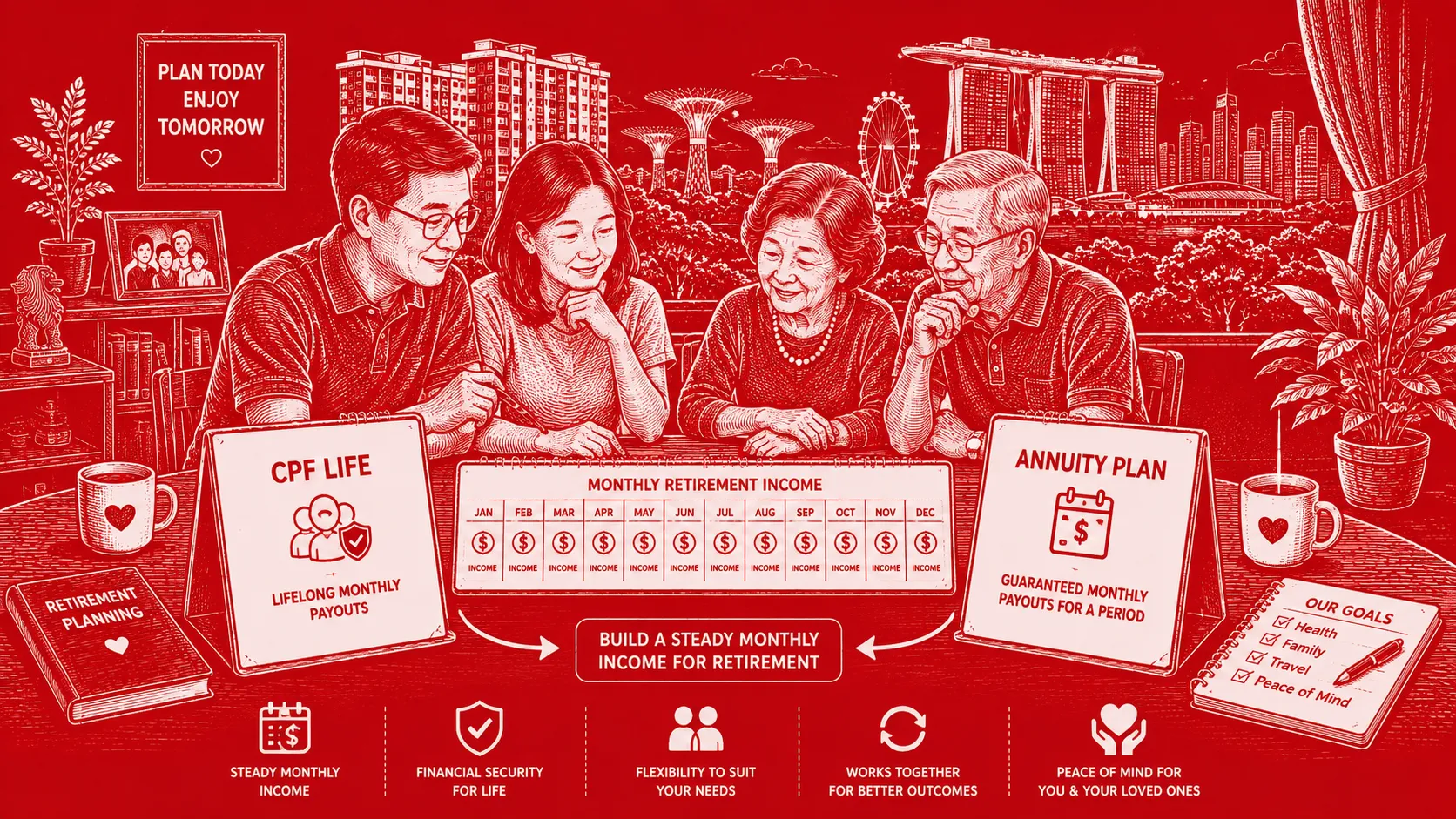
Introduction
For many Singaporeans, CPF LIFE payout is one of the most important parts of retirement income planning. It provides monthly payouts for life, which means you do not have to worry about your CPF retirement payouts stopping simply because you live longer than expected. This is why CPF LIFE is often described as a lifelong retirement income foundation.
However, CPF LIFE is not just about choosing the plan with the highest starting monthly payout. The payout you receive depends on several factors, including how much you have in your Retirement Account, when you start your payouts, and whether you choose the Standard Plan, Basic Plan, or Escalating Plan. Each plan works differently, and the best choice depends on your retirement cash flow needs.
This article explains CPF LIFE payout in plain English. It covers how your Retirement Account supports your payouts, how Basic, Full and Enhanced Retirement Sum affect the payout amount, whether you should delay your payout from age 65 to 70, and how the Standard, Basic and Escalating Plans compare.
What CPF LIFE Payout Means
CPF LIFE stands for CPF Lifelong Income For the Elderly. It is a national longevity insurance annuity scheme that provides monthly payouts for as long as you live. The purpose is to reduce the risk of outliving your retirement savings, especially as people live longer and retirement may last for many years.
Your CPF LIFE payout is mainly affected by three factors. The first is how much you have in your Retirement Account. The second is when you choose to start your payout, which can be any time between 65 and 70. The third is the CPF LIFE plan you choose: Standard, Basic, or Escalating.
All three CPF LIFE plans provide monthly payouts for life. The difference is not that one plan is good and the others are bad. The difference lies in the payout pattern, the bequest trade-off, and how much you want your payout to account for rising costs over time.
How Your Retirement Account Supports CPF LIFE Payouts
To understand CPF LIFE payout properly, it helps to understand how your Retirement Account works. When you reach age 55, your CPF savings are transferred from your Special Account, followed by your Ordinary Account, into your Retirement Account up to your Full Retirement Sum. This Retirement Account is meant to support your retirement payouts.
Before CPF LIFE payouts start, the savings in your Retirement Account continue to earn CPF interest. This matters because the Retirement Account is not just a holding account. The amount you set aside there affects your future monthly retirement income. In general, higher Retirement Account savings can support a higher CPF LIFE payout, all else being equal.
When CPF LIFE payouts start, your Retirement Account savings are used as CPF LIFE premiums, depending on the plan you choose. For the Standard Plan and Escalating Plan, the savings in your Retirement Account are deducted as CPF LIFE premiums when your payouts start. Your monthly payouts are first paid from your CPF LIFE premium.
When your CPF LIFE premium is depleted, your payouts do not stop. They continue to be paid from the accumulated interest in the CPF LIFE pool. This is the risk-pooling feature of CPF LIFE. The interest earned on CPF LIFE premiums is pooled with other CPF LIFE members' premiums, helping fund payouts for members who live longer.
The Basic Plan works differently. Under the Basic Plan, only about 10% to 20% of your Retirement Account savings is deducted as a CPF LIFE premium when you join CPF LIFE. The remaining Retirement Account savings are streamed out as monthly payouts in later years. This is one reason the Basic Plan has a different payout and bequest pattern from the Standard and Escalating Plans.
A useful way to understand CPF LIFE is this: it is not simply withdrawing your own CPF savings until the balance becomes zero. CPF LIFE uses annuity premiums and risk-pooling to provide payouts for as long as you live. However, retirees should also understand that, while CPF LIFE provides lifelong payouts, the payout amount may be adjusted if long-term assumptions, such as mortality experience, change.
Basic, Full and Enhanced Retirement Sum
Do not confuse CPF LIFE plans with CPF retirement sums. CPF LIFE plans are Standard, Basic and Escalating. CPF retirement sums are Basic Retirement Sum, Full Retirement Sum and Enhanced Retirement Sum. They are related, but they are not the same thing.
The retirement sum affects how much you set aside in your Retirement Account. The more you set aside, the higher your CPF LIFE payout is likely to be. The Basic Retirement Sum is meant to cover basic retirement needs, excluding rental expenses. The Full Retirement Sum is a useful reference point for retirement planning. The Enhanced Retirement Sum allows members aged 55 and above to top up their Retirement Account for higher monthly payouts.
For 2026, CPF states that the Basic Retirement Sum is $110,200 and the Full Retirement Sum is $220,400 for members turning 55 in 2026. CPF also states that the Enhanced Retirement Sum for 2026 is $440,800, which is the maximum amount members aged 55 and above can top up their Retirement Account to in 2026.
One important warning is that setting aside more in your Retirement Account does not always mean you can freely withdraw the excess later. Some Retirement Account savings may be withdrawable under CPF property withdrawal rules, but top-ups, government grants, and interest earned are generally not withdrawable as a lump sum. CPF top-ups should therefore be treated as a long-term commitment to higher retirement payouts, not as a short-term parking strategy for interest.
This article is not meant to go deeply into CPF withdrawal at age 55, property pledges, or lump sum withdrawal rules. The key point is simpler: your CPF LIFE plan affects the payout pattern, while your retirement sum affects the payout amount.
Should You Delay CPF LIFE Payout from 65 to 70?
CPF LIFE payouts can start at any time between the ages of 65 and 70. If you do not need the money immediately at age 65, delaying your CPF LIFE payout can increase your future monthly payout. CPF states that payouts may increase by up to 7% for each year that you defer.
This can be attractive to people who have sufficient cash savings, receive rental income, have other investment income, or do not need a CPF LIFE payout immediately for daily expenses. By delaying, they may receive a higher, lifelong monthly payout later, which can be useful if they want a higher income after fully stopping work.
However, delaying CPF LIFE payout is not automatically better for everyone. If you need income at age 65 for food, utilities, transport, healthcare, insurance premiums, or family expenses, delaying may create unnecessary cash flow stress. If your health is poor, or if you do not have other reliable income between the ages of 65 and 70, starting earlier may be more practical.
The decision should not be treated purely as a mathematical one. It is a retirement cash flow decision. The key question is: can you comfortably fund your expenses between the ages of 65 and 70 without a CPF LIFE payout? If the answer is yes, delaying may be worth considering. If the answer is no, a higher payout later may not help if you struggle with cash flow today.
CPF LIFE Standard Plan
The CPF LIFE Standard Plan provides steady monthly payouts. Among the three current CPF LIFE plans, it is often the easiest for many people to understand because the payout pattern is more straightforward. You receive a higher, steady monthly payout compared to plans that start lower.
This plan may suit retirees who rely heavily on CPF LIFE payout for monthly expenses. If your CPF LIFE payout will form a major part of your retirement income, a steady and relatively higher starting payout can make budgeting easier. It may be useful for people who want predictability and do not want to manage too much variation in monthly retirement income.
The trade-off is that the bequest may generally decline faster than under the Basic Plan. This is because more of your Retirement Account savings are used as CPF LIFE premium when payouts start. The Standard Plan may therefore be more suitable for someone who prioritises monthly income over leaving more CPF balance behind.
CPF LIFE Basic Plan
The CPF LIFE Basic Plan starts with lower monthly payouts than the Standard Plan. CPF also explains that Basic Plan payouts can decline progressively as CPF balances fall below $60,000. This is an important point because some people may wrongly assume that the Basic Plan payout will remain stable for life.
The Basic Plan may leave more of a bequest than the Standard Plan in some situations. This may appeal to people who are more concerned about leaving some CPF savings behind for loved ones. However, the bequest angle should not be the only reason to choose the Basic Plan.
The bigger question is whether the retiree can accept a lower income and a possible reduction in the payout later. If someone already needs a higher monthly income for daily expenses, the Basic Plan may not be suitable. Monthly income needs should come first, especially if CPF LIFE payout is expected to cover a meaningful part of retirement spending.
CPF LIFE Escalating Plan
The CPF LIFE Escalating Plan starts with lower monthly payouts and increases by 2% each year. It is designed for people concerned about the rising cost of living and who want their CPF LIFE payout to grow over time.
This can be useful because retirement may last 20 to 30 years or more. The amount that feels comfortable at age 65 may not feel the same at age 80 if prices have risen. The Escalating Plan addresses this by accepting a lower starting payout in exchange for annual increases.
The trade-off is that the early retirement years may feel tighter. If you need more income immediately when payouts start, the lower starting payout may be uncomfortable. The Escalating Plan may be more suitable for people with other income sources in the early retirement years who want greater protection against future inflation.
Standard vs Basic vs Escalating
The simplest way to compare the three CPF LIFE plans is to look at the payout pattern. The Standard Plan offers a higher, steady payout. The Basic Plan gives a lower payout, may be reduced later, and may leave more bequest in some situations. The Escalating Plan gives a lower starting payout but increases by 2% every year.
There is no one best CPF LIFE plan for everyone. A retiree who needs a stable monthly income may prefer the Standard Plan. A retiree who is more willing to accept a lower income and wants to preserve more bequest may consider the Basic Plan. A retiree who worries about rising costs and can accept a lower starting payout may consider the Escalating Plan.
The important point is to compare the payout pattern, not just the first-month payout. A higher starting payout may look attractive, but it may not address inflation. A lower starting payout may be acceptable if you have other income sources. The correct choice depends on how the payout pattern fits your actual retirement life.
CPF LIFE Payout and Retirement Expenses
Before choosing a CPF LIFE plan, start with your expected retirement expenses. Estimate how much you may need each month for food, transport, utilities, healthcare, insurance premiums, family support, leisure, and other recurring costs. Then compare that amount with your estimated CPF LIFE payout.
If your expected expenses exceed your CPF LIFE payout, you need to identify the income gap. Other sources may include cash savings, SRS withdrawals, annuity plans, dividends, rental income, part-time work, or family support. CPF LIFE can be a strong foundation for retirement income, but it may not be the entire retirement plan for everyone.
This is also why the payout pattern matters. If you expect expenses to be high in early retirement, a lower starting payout may be difficult. If you expect inflation to be a bigger problem later, an increasing payout may be worth considering. If you want simple budgeting, a steady payout may be easier to manage.
A useful question to ask is: Will this CPF LIFE payout pattern match how I actually spend in retirement? That question is more practical than asking which plan sounds best on paper.
Common CPF LIFE Payout Mistakes
One common mistake is choosing based only on the highest starting payout. A higher first-month payout may feel attractive, but retirement planning is not only about the first month. You need to consider whether the payout stays level, may be reduced later, or increases over time.
Another mistake is ignoring inflation. If your expenses rise over the years but your payout does not increase, your purchasing power may weaken. This does not mean everyone should automatically choose the Escalating Plan, but inflation should be part of the decision.
A third mistake is choosing the Basic Plan mainly for bequest without checking income needs. Leaving money behind may be important, but if the retiree needs more income for daily living, choosing a lower payout may create unnecessary stress. Retirement income should not be sacrificed blindly for bequest.
A fourth mistake is choosing the Escalating Plan without enough income in early retirement. The 2% yearly increase can be useful over time, but the starting payout is lower. If you do not have enough cash savings, work income, or other retirement income, the early years may feel too tight.
A fifth mistake is deferring payouts without proper cash flow. Delaying from age 65 to 70 may increase future payouts, but you still need money to live on during those five years. Deferral is useful only if you can afford to wait.
A sixth mistake is thinking CPF LIFE is simply withdrawing your own money until it runs out. CPF LIFE is an annuity scheme with risk-pooling, which is why payouts can continue for life even after your own CPF LIFE premium is depleted. Understanding this helps retirees make better decisions about payout plans and bequest expectations.
A seventh mistake is treating the estimated CPF LIFE payout as a number that will never change. CPF LIFE provides lifelong payouts, but payout amounts may be adjusted if long-term assumptions change. It is still sensible to leave some buffer in your retirement plan.
Questions Before Choosing a CPF LIFE Plan
Before choosing your CPF LIFE plan, ask yourself how much monthly income you actually need. This should include basic living expenses, healthcare costs, insurance premiums, family commitments, and some allowance for lifestyle and emergencies. If you do not know your monthly expenses, it is difficult to choose a proper payout plan.
Next, ask how much of your expenses can be covered by CPF LIFE payout. If CPF LIFE covers most of your essential spending, a stable payout may be important. If CPF LIFE covers only part of your expenses and you have other income sources, you may have more flexibility to consider a lower starting payout or delayed payout start age.
You should also ask whether you are more concerned about monthly income, inflation, or bequest. These three goals often pull in different directions. Wanting a higher income today, increasing income in future, and more bequests for loved ones may not all be maximised at the same time.
Finally, ask whether you can afford to defer CPF LIFE payout and whether you understand how the Standard, Basic, and Escalating Plans differ. It is also useful to try CPF’s payout estimator before deciding, because actual estimates depend on your own CPF balances, selected payout start age, and plan choice.
Conclusion: Choose Based on Retirement Cash Flow
CPF LIFE payouts are an important foundation of retirement income for Singaporeans. It provides monthly payouts for life and helps reduce the risk of outliving your retirement savings. However, choosing a CPF LIFE plan should not be done casually.
The Standard Plan, Basic Plan, and Escalating Plan solve different needs. The Standard Plan focuses on a steady monthly income. The Basic Plan may appeal to those who can accept lower payouts and want to preserve more bequest in some situations. The Escalating Plan starts lower but increases each year to help offset rising costs.
There is no one best CPF LIFE plan for everyone. The better question is whether the payout structure fits your retirement cash flow, inflation concern, bequest preference, health, payout start age, and other income sources.
Do not choose the plan by name alone. Choose the CPF LIFE payout structure based on how it supports the retirement life you are actually planning for.
Frequently Asked Questions
Your CPF LIFE payout depends on several factors, including your Retirement Account savings, the CPF LIFE plan you choose, the age you start your payouts, and the prevailing CPF LIFE payout rates. Generally, higher retirement savings and a later payout start age result in higher monthly payouts.
Yes. You may be able to increase your CPF LIFE payout by building up your Retirement Account, making eligible CPF top-ups, delaying your payout start age up to age 70, or choosing a CPF LIFE plan that better suits your retirement needs.
It depends on your retirement income needs and personal circumstances. Starting at 65 provides income earlier, while delaying your payouts up to 70 increases your monthly payout. Consider your expected retirement expenses, health and other sources of retirement income before deciding.
The Standard Plan generally provides the highest initial monthly payout. The Basic Plan starts with a lower payout but leaves more of your Retirement Account balance available for your beneficiaries. The Escalating Plan starts with a lower payout than the Standard Plan but increases by 2% each year to help offset inflation.
Not necessarily. Only the Escalating Plan is designed to increase monthly payouts by 2% each year. The Standard and Basic Plans generally provide level monthly payouts throughout retirement.
Continuing to work does not stop your CPF LIFE payouts. However, your ongoing CPF contributions and retirement planning decisions may affect your overall retirement income depending on your circumstances.
When you pass away, any remaining CPF LIFE premium, if applicable, is generally paid to your CPF nominees or distributed according to the applicable CPF rules if no nomination has been made.
Generally, no. Once your CPF LIFE payouts begin, your plan choice is usually irreversible. It is therefore important to understand the differences between the Standard, Basic and Escalating Plans before making your decision.
Not necessarily. The highest monthly payout is not always the most suitable option. Consider factors such as your retirement lifestyle, inflation, other retirement income sources and whether leaving more money for your beneficiaries is important to you.
The best CPF LIFE payout plan depends on your retirement goals rather than simply choosing the highest monthly payout. If you prefer higher income from the start of retirement, the Standard Plan may be suitable. If leaving a larger bequest is important, the Basic Plan may better meet your needs. If you are concerned about inflation reducing your purchasing power over time, the Escalating Plan may be worth considering. Review your retirement income, expected expenses and other financial resources before making your decision.