SRS Withdrawal Rules: How to Avoid Costly Tax Mistakes in Retirement
Table Of Contents
Introduction
Many Singaporeans use the Supplementary Retirement Scheme (SRS) to reduce income tax while setting aside money for retirement. On the surface, it sounds simple: contribute money to your SRS account, enjoy tax relief, invest the funds, and withdraw them later during retirement.
However, SRS is not just a tax-saving account. It comes with withdrawal rules, tax treatment, penalties, contribution limits, and planning considerations that can affect how useful it really is. If you contribute to SRS without understanding how withdrawals work, you may enjoy tax relief today but face unnecessary tax issues later.
This is especially important for Singaporeans approaching retirement. The way you withdraw from SRS can affect your taxable income, retirement cash flow, and overall financial planning. A poorly planned withdrawal may reduce some of the tax benefits you were trying to enjoy in the first place.
This article explains the key SRS withdrawal rules in plain English, so you can better understand how SRS works, what mistakes to avoid, and how it may fit into retirement planning in Singapore.
What Is SRS, Why Singaporeans Use It, and When Withdrawals Can Start
SRS is a voluntary retirement savings scheme in Singapore that complements CPF. Unlike CPF, which is a compulsory national savings scheme for many working Singaporeans, SRS is optional. You decide whether to open an SRS account, how much to contribute each year, and how to use the funds within the rules of the scheme.
Many Singaporeans use SRS because contributions can reduce taxable income. For example, if you contribute to SRS, the contribution may qualify for tax relief, subject to the annual contribution cap and the overall personal income tax relief cap. This can be useful for people in higher income tax brackets who want to set aside money for retirement while lowering their tax bill today.
However, SRS should not be treated as “free tax savings”. The money you contribute may reduce taxable income now, but withdrawals may still be taxable later. It works best when the contribution, investment, and withdrawal plans are considered together.
SRS withdrawal age is also important. For Singapore Citizens and Permanent Residents, the relevant retirement age is generally based on the statutory retirement age that applied when you made your first SRS contribution. This matters because once you make your first contribution, that retirement age is locked in for determining when you can make penalty-free retirement withdrawals.
In simple terms, SRS is useful only if you can set aside the money until retirement or another permitted withdrawal event. If you are likely to need the money before the eligible withdrawal age, SRS may be less suitable because early withdrawals can be costly.
How SRS Contributions Work and Why It Is Not “Free Tax Savings”
SRS contributions are voluntary and subject to annual caps. For Singapore Citizens and Permanent Residents, the annual contribution cap is lower than the cap for foreigners. The contribution limits are important because only contributions within the allowed cap can qualify for SRS tax relief.
Singaporeans usually think of SRS as a tax-saving tool, but that is only one side of the picture. When you contribute to SRS, you may reduce taxable income for that year. Later, when you withdraw from SRS, part or all of the withdrawal may be taxable, depending on when and why you withdraw.
This is why SRS should be understood as a retirement planning tool rather than a simple tax trick. If you contribute during your higher-income years and withdraw carefully during retirement when your taxable income is lower, SRS may help reduce your lifetime tax burden. But if you withdraw too early, withdraw too much in one year, or fail to plan your taxable income during retirement, the benefit may be reduced.
Another important point is that SRS cash earns only about 0.05% p.a. if left idle. This means contributing to SRS is not the full strategy. If the money simply sits in cash for many years, inflation may quietly reduce its real value. The tax relief may still be useful, but the retirement planning outcome may be weaker than expected.
Because of this, anyone using SRS should think beyond the contribution itself. You need to consider whether you can leave the money until retirement, how you will invest the funds, how much liquidity you need elsewhere, and how you may eventually withdraw the money.
SRS Withdrawal After Retirement Age
The most commonly discussed SRS withdrawal rule applies when withdrawals are made on or after the applicable retirement age. In this situation, only 50% of the withdrawal amount is taxable. This is one of the main tax advantages of SRS during retirement.
For example, if you withdraw $30,000 from SRS after reaching the applicable retirement age, only $15,000 is taxable. Whether you actually pay income tax on that taxable amount depends on your total taxable income, personal reliefs, and Singapore’s income tax rates at that time.
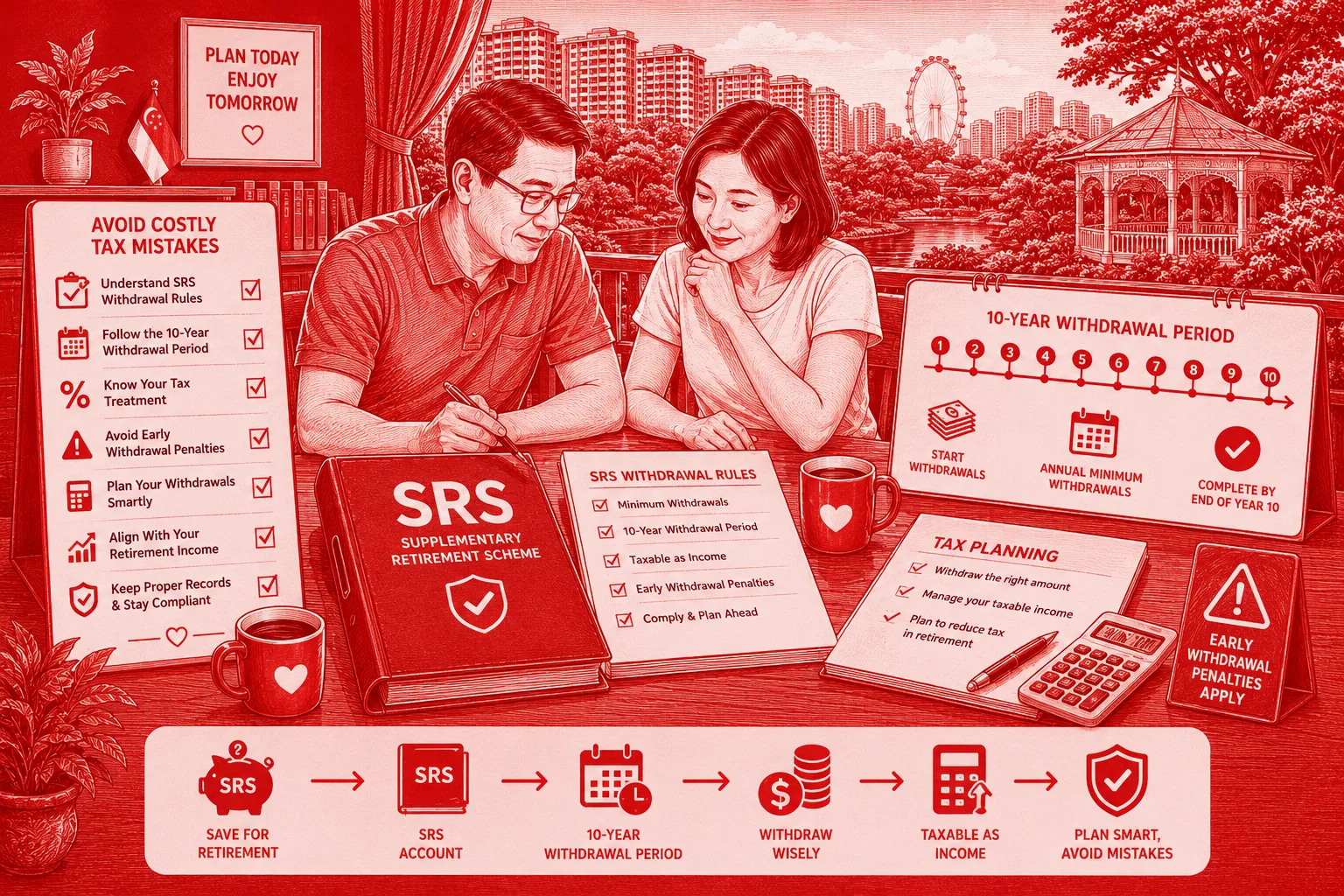
SRS retirement withdrawals are generally spread over a maximum period of 10 years. This 10-year withdrawal window is important because it gives retirees the opportunity to plan withdrawals more carefully, rather than taking everything out at once. If you withdraw too much in one year, the taxable portion may push you into a higher tax bracket. If you spread withdrawals more evenly, you may be able to manage your tax position more efficiently.
An SRS member with no other taxable income and reliefs may currently withdraw up to $40,000 per year tax-free after the applicable retirement age, because only 50% of the withdrawal is taxable. Over 10 years, this means up to $400,000 may be withdrawn tax-free in that specific situation. However, this assumes there is no other taxable income and no other reliefs, so it should not be blindly applied to everyone.
This is where retirement income planning becomes practical. If you will also receive rental income, business income, or other taxable income during retirement, your SRS withdrawal plan should take those into account. For example, if someone receives high rental income during retirement and is already taxed at the highest marginal tax bracket, the 50% of the SRS withdrawal that is taxable may also be taxed at that high bracket. In that situation, the SRS tax benefit may be much smaller than expected. This is why SRS should be coordinated with your overall tax and retirement income picture, not withdrawn randomly.
Early SRS Withdrawal Before Retirement Age
Early SRS withdrawal usually refers to withdrawing before the applicable retirement age. This can be expensive because early withdrawals are generally 100% taxable and may also attract a 5% penalty. In other words, the full amount withdrawn may be added to your taxable income, and you may also lose an additional 5% as a penalty.
This is one reason why SRS may not be suitable for money that you may need in the short term. If you contribute to SRS today but later need the money for emergency expenses, housing, family support, medical needs, or cash flow problems, the early withdrawal rules may create an unpleasant outcome.
Before contributing to SRS, it is sensible to make sure you already have sufficient emergency savings outside SRS. Retirement planning should not make your present-day finances fragile. If every spare dollar is locked away and you have no liquid buffer, you may be forced to withdraw SRS funds at the wrong time.
There are exceptions and special situations where different withdrawal treatment may apply, but the general principle is simple: SRS is designed for retirement, not short-term cash access. If you may need the money before retirement, think twice before contributing too aggressively.
SRS Withdrawal for Terminal Illness or Death
SRS withdrawal rules may differ for withdrawals due to terminal illness, bankruptcy, or death. These situations are different from normal early withdrawals or planned retirement withdrawals, and they may have different tax and penalty treatment.
For example, when an SRS member passes away or withdraws on grounds of terminal illness, the SRS balance may be deemed withdrawn or treated under special withdrawal rules. This does not necessarily mean the full SRS amount is taxable. Under current IRAS rules, if the SRS member had not started the 10-year withdrawal period, the full $400,000 exemption may apply. Any remaining amount after the applicable exemption is then 50% taxable.
This means a person who passes away before retirement, or who withdraws SRS funds due to terminal illness, may not have taxable SRS withdrawal income if the SRS balance is below the applicable exemption threshold. However, if the SRS balance is large, or if the person has already started penalty-free withdrawals, part of the SRS balance may still be taxable. This is why SRS should not be viewed only from an income tax angle; it can also affect estate, legacy, and medical crisis planning.
The practical takeaway is that SRS should be included in your broader retirement and legacy planning. If your family does not know you have an SRS account, or if you have not considered how it fits with your estate plan, it may create confusion later.
How SRS Investments Affect Withdrawal Planning
Contributing to SRS is only the first step. The next question is: what happens to the money in the SRS account? If your SRS money is left as cash, it usually earns only about 0.05% p.a. This is very low, especially when compared with inflation over many years.
This is why many people choose to invest their SRS funds. Depending on what is available through their SRS operator and investment platform, SRS funds may be used for various investments such as unit trusts, shares, bonds, ETFs, Singapore Savings Bonds, fixed deposits, or other approved instruments. The available options may differ by provider and product.
Investment returns within SRS are generally tax-free before withdrawal. This can be useful because the funds may compound inside the SRS account without being taxed along the way. However, investments also carry risk. The value may rise or fall, and there is no guarantee that your SRS investments will perform well.
This creates an important issue in retirement planning. If your SRS funds are invested, you need to think about liquidity before the withdrawal period begins. An investment may be suitable when you are 45, but it may not be suitable when you are 63 and preparing to withdraw the money. If the investment falls in value just before you need to withdraw, or if it is difficult to sell, your retirement cash flow may be affected.
A common approach is to review SRS investments as retirement gets closer. This does not mean everyone must sell everything and hold cash, but it does mean the investment mix should match the withdrawal timeline, risk tolerance, and income needs. SRS is not just about tax relief; it is also about managing the money properly until withdrawal.
Common SRS Tax Mistakes
One common SRS mistake is contributing without a withdrawal plan in place. Many people focus on the tax relief today but do not think about how the money will eventually be withdrawn. This can create problems later if the SRS account grows substantially and the retiree has to withdraw a large amount within the 10-year withdrawal period.
Another mistake is over-contributing without considering future taxable income. SRS can be useful for higher-income earners, but if you expect to have significant taxable income during retirement, such as rental income, consulting income, business income, or part-time employment income, your SRS withdrawals may still be taxed. The benefit may remain, but it may not be as large as expected.
A third mistake is failing to plan regular withdrawals over the 10-year period. Some people assume they can slowly withdraw SRS over the rest of their lives, but retirement withdrawals are generally subject to the 10-year maximum. This means you should plan a withdrawal schedule instead of leaving everything until the end. Withdrawing a reasonable amount each year may help smooth out taxable income, while withdrawing everything at once may result in a much larger taxable amount that year.
A fourth mistake is withdrawing too much in one year. Taking a large SRS withdrawal may feel convenient, especially if you want to simplify your finances, but it may increase taxable income for that year. Since SRS withdrawals are added to your other taxable income, a large withdrawal may be taxed at a higher marginal tax rate if you already have employment income, rental income, business income, or other taxable income.
A fifth mistake is assuming that unused SRS funds can simply remain untouched forever after the 10-year period. Under current rules, you do not necessarily have to physically withdraw all remaining SRS funds at the end of the 10-year withdrawal period, but 50% of the balance remaining in the SRS account at the end of 10 years will still be subject to tax. Certain arrangements, such as qualifying life annuity payments, may receive special treatment, but this depends on the specific product and rules. This is why the 10-year withdrawal window should be actively planned, not ignored.
A sixth mistake is leaving SRS investments illiquid too close to retirement. If your SRS funds are locked into investments that cannot be easily sold, or if market conditions are poor when you need to withdraw, you may face timing problems. Investment planning and withdrawal planning should work together, especially as you approach the start of your SRS withdrawal period.
Who Might Find SRS Useful
SRS may be useful for higher-income earners who are paying income tax and want to set aside additional money for retirement. The higher your marginal tax rate, the more meaningful the immediate tax relief may be, although the final benefit still depends on future withdrawal planning.
It may also be useful for people who already have sufficient emergency savings and do not need the SRS money before retirement. This is important because early withdrawals can be costly. SRS works better when the money can remain untouched until the eligible withdrawal age.
People who are comfortable investing may also find SRS useful. If funds are invested appropriately based on risk tolerance and time horizon, SRS may become a more effective retirement planning tool.
SRS may also appeal to people who understand that the benefit is not simply “save tax now”. The real value comes from combining tax relief, long-term investing, and careful withdrawal planning. Without all three, the outcome may be less attractive.
Who Should Be Careful With SRS
SRS may not be suitable for everyone. People with unstable cash flow should be careful because SRS money is not meant for short-term use. If you may need the funds before retirement, the early withdrawal tax and penalty can make SRS less attractive.
People with little emergency savings should also be careful. Before contributing aggressively to SRS, it may be wiser to build a cash buffer for unexpected expenses. Retirement planning should not leave you with tax relief on paper but no cash when life happens.
SRS may also be less suitable for people who do not want investment risk but also do not want to leave money earning very low interest. If you are uncomfortable investing SRS funds, you need to understand that cash returns may be low. If you are comfortable investing, you still need to accept that investment values can go down.
People who expect substantial taxable income in retirement should also think carefully. SRS may still be useful, but the withdrawal strategy becomes more important. If the taxable portion of SRS withdrawals is added to other retirement income, the tax benefit may be smaller than expected.
Conclusion: Plan SRS Before You Withdraw
SRS can be a useful retirement planning tool for Singaporeans, but it works best when used with a clear plan. The main benefit is tax deferral. Contributions may reduce taxable income today, investment returns are tax-free before withdrawal, and only 50% of retirement withdrawals are taxable if the rules are met.
However, SRS can also create problems if used carelessly. Early withdrawals may be fully taxable and may attract a 5% penalty. Retirement withdrawals are generally subject to a 10-year withdrawal period. Large withdrawals may increase taxable income. Leaving SRS cash idle at about 0.05% p.a. may also weaken the long-term benefit.
For most Singaporeans, the better approach is to treat SRS as one part of a broader retirement income plan. It should be considered alongside CPF LIFE, cash savings, investments, insurance planning, healthcare costs, and family needs. SRS can be helpful, but it is not magic.
Before contributing or withdrawing, take time to understand the SRS rules, your likely retirement income, your tax position, and your liquidity needs. The goal is not just to save tax today. The goal is to avoid costly mistakes and use SRS in a way that meaningfully supports your retirement in Singapore.
Frequently Asked Questions
The Supplementary Retirement Scheme (SRS) is a voluntary savings scheme that encourages Singaporeans and eligible foreigners to save for retirement. Contributions to SRS may qualify for tax relief, while the funds can be invested to help grow your retirement savings.
Singapore Citizens, Permanent Residents and eligible foreigners who meet the scheme’s requirements can open an SRS account with an approved SRS operator.
No. SRS is entirely voluntary. You decide whether to contribute, how much to contribute each year (up to the prevailing contribution limit) and whether it fits your retirement and tax planning objectives.
The main benefits include:
- Income tax relief on eligible contributions
- Opportunities to invest your SRS savings
- Tax concessions on eligible withdrawals during retirement
The actual benefits depend on your personal financial circumstances.
Yes, but withdrawals made before the prescribed retirement age generally incur tax on the full withdrawal amount and may be subject to a 5% penalty, unless an exception applies under the SRS rules.
Yes. SRS funds can generally be invested in a range of approved investment products, including unit trusts, ETFs, selected shares, bonds, insurance products and fixed deposits, subject to the prevailing SRS investment rules.
Not necessarily. SRS tends to be more beneficial for individuals who pay income tax and are looking for additional retirement savings. Whether it is suitable depends on your income, tax bracket, retirement plans and overall financial goals.
You can begin making penalty-free withdrawals from your SRS account from the applicable statutory retirement age for your first contribution, subject to the prevailing SRS withdrawal rules and tax treatment.
Your SRS savings form part of your estate and are distributed according to your will or the applicable succession laws if no valid will exists. Different tax rules may apply to SRS balances upon death.
It depends on your financial objectives. CPF top-ups may be suitable if your priority is building guaranteed retirement savings and potentially enjoying tax relief, while SRS offers tax relief together with greater investment flexibility. Many Singaporeans use both as part of a balanced retirement strategy, depending on their income, tax position and retirement goals.