Lasting Power of Attorney Singapore: 7 Important Things to Know Before You Make One
Table Of Contents
Introduction
A Lasting Power of Attorney Singapore arrangement is one of the most important planning tools you can put in place before anything happens to your mental capacity. Many Singaporeans understand the importance of writing a will or making a CPF nomination, but these documents primarily address what happens after death. A Lasting Power of Attorney, often shortened to LPA, deals with a different situation: what happens if you are still alive, but you lose mental capacity and can no longer make decisions for yourself.
This can happen because of dementia, stroke, serious illness, accident, or other medical conditions that affect your ability to understand and make decisions. When this happens, your family may need to make decisions about your care, medical arrangements, living situation, bank accounts, property, and financial matters. Without a valid Lasting Power of Attorney, your loved ones may not automatically have the legal authority to act for you. They may need to apply to the court to be appointed as your deputy, which can take time, cost money, and create unnecessary stress during an already difficult period.
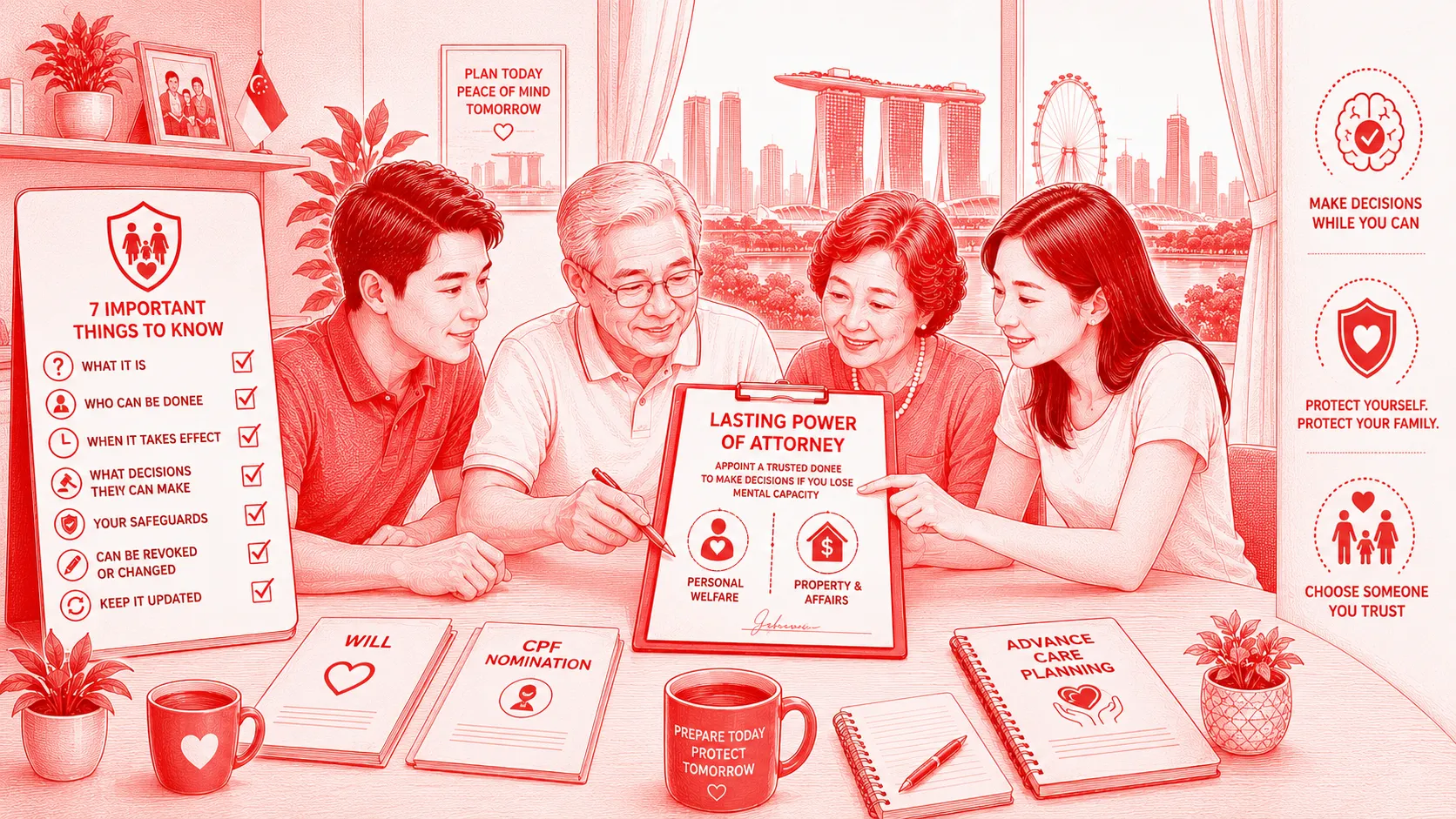
A Lasting Power of Attorney Singapore application allows you, while you still have mental capacity, to appoint one or more trusted people to make decisions on your behalf if you lose mental capacity in future. Here are 7 important things Singaporeans should know before making one.
1. A Lasting Power of Attorney Is for Loss of Mental Capacity, Not Death
The first thing to understand is that a Lasting Power of Attorney is not the same as a Will. A Will deals with how your estate should be distributed after you pass away. A Lasting Power of Attorney deals with who can make decisions for you while you are still alive, if you lose mental capacity. This difference is important because a will does not help your family manage your affairs while you are still living, but mentally incapacitated.
For example, if a person suffers a serious stroke and can no longer communicate or make decisions, the will does not help the family manage that person’s financial affairs. The will only becomes relevant after death. During the person’s lifetime, the family may still need someone with legal authority to handle practical matters. A Lasting Power of Attorney Singapore arrangement can help with this by allowing your appointed person, known as your donee, to make decisions on your behalf if you lose mental capacity.
These decisions may relate to your personal welfare, your property and affairs, or both. Personal welfare matters may include care arrangements, where you live, and daily welfare decisions. Property and affairs matters may include bank accounts, bills, property, and other financial matters. The key point is simple: a will protects your wishes after death, while a Lasting Power of Attorney helps protect your interests while you are still alive but unable to decide for yourself. Both are important, but they serve different purposes.
2. You Must Make Your LPA While You Still Have Mental Capacity
A Lasting Power of Attorney must be made before you lose mental capacity. This is a point that many people delay until it is too late. They may think, “I am still healthy, so I do not need this now.” But the whole point of making a Lasting Power of Attorney Singapore application is to prepare for the future. If a person has already lost mental capacity, that person can no longer make a valid LPA. At that stage, family members may need to apply to the court to be appointed as deputies instead.
That process is different from making an LPA. It may involve more paperwork, more time, and additional legal costs. This is why an LPA should not be seen as something only for the elderly. Any adult can lose mental capacity because of an accident, illness, or sudden medical event. It is uncomfortable to think about, but planning ahead is usually easier than trying to fix things after the crisis has already happened.
In Singapore, you must generally be at least 21 years old and have the mental capacity to make an LPA. You should also understand what powers you are giving to your donee and the consequences of making the document. This is why the LPA certificate issuer plays an important role. The certificate issuer helps confirm that you understand the purpose of the LPA, that you are not being forced into making it, and that there is no fraud or undue pressure involved. A Lasting Power of Attorney is not just a form. It is a serious legal document, so make it when you are still clear, calm, and able to make a proper choice.
3. Your Donee Should Be Someone You Trust Deeply
The person you appoint under your Lasting Power of Attorney is called your donee. Your donee is the person who may make decisions for you if you lose mental capacity in future. This is why choosing the right donee is one of the most important parts of creating a Lasting Power of Attorney in Singapore.
A donee should not simply be the eldest child, the most vocal sibling, or the person who happens to live nearest to you. The donee should be someone you trust to act in your best interests, respect your wishes, and handle responsibility properly. For many people, the donee may be a spouse, an adult child, a sibling, a close relative, or a trusted friend. The person should be willing to act, emotionally steady, financially responsible, and able to work with other family members if needed.
You should also consider whether the person understands you well. If you lose mental capacity, your donee may need to make decisions about your care, living arrangements, or financial matters. A good donee should know your values, preferences, and family situation. For example, would you prefer to be cared for at home if possible? Would you be comfortable staying in a care facility if your needs become too difficult for the family to manage? How should your money be used for your own care? Are there family members who depend on you financially? These are not just legal questions. They are personal questions. A Lasting Power of Attorney gives authority, but the quality of the decision still depends on the person you appoint.
4. You Can Appoint Donees for Personal Welfare, Property and Affairs, or Both
A Lasting Power of Attorney Singapore application can cover different types of decisions. The two broad areas are personal welfare and property and affairs. Personal welfare decisions relate to your care and well-being. This may include where you live, who cares for you, and certain healthcare or daily living decisions, depending on the powers granted.
Property and affairs decisions relate to money and financial matters. This may include managing bank accounts, paying bills, dealing with property, handling expenses, and managing assets for your benefit. You may appoint the same donee for both areas, or different donees for different areas, depending on your situation.
For example, your spouse may understand your care preferences very well and be suitable for personal welfare decisions. But if your spouse is not comfortable managing money, you may prefer to appoint an adult child or another trusted person for property and affairs decisions. For some families, appointing one donee may be simpler. For others, appointing two donees may provide a better balance. The right structure depends on your family dynamics, the complexity of your assets, and the level of trust between the people involved.
You should also think about whether your donees are likely to work well together. If two people are appointed, but cannot agree on anything, your LPA may create friction rather than clarity. The aim is not to create a perfect legal document that looks nice on paper. The aim is to create a practical arrangement that can work in real life when your family is under stress.
5. Most Singaporeans Use LPA Form 1, But Some May Need LPA Form 2
In Singapore, there are two main LPA forms: Form 1 and Form 2. LPA Form 1 is for donors who want to give the donees general powers with basic restrictions. According to the Ministry of Social and Family Development, 98% of Singapore Citizens who have made an LPA used LPA Form 1 (as of Jun 2026). LPA Form 2 is for donors who want to give customised powers. The clauses in LPA Form 2 have to be drafted by a lawyer qualified to practise Singapore law.
For most Singaporeans with straightforward family and financial situations, LPA Form 1 may be sufficient. It allows you to appoint donees for personal welfare and/or property and affairs within the standard structure. However, some people may need more customised planning, especially if they have business ownership, complex property arrangements, a blended family, dependants with special needs, or more detailed restrictions on what the donee can or cannot do.
In such cases, LPA Form 2 may be more appropriate, but it requires legal drafting and should not be treated casually. The main difference is flexibility. Form 1 is simpler and commonly used. Form 2 offers more customisation but is more complex. If your situation is simple, Form 1 may be enough. If your assets, family structure, or instructions are more complex, you should consider getting legal advice before deciding. The right Lasting Power of Attorney in Singapore should reflect your actual life, not just the cheapest or fastest option.
6. Making an LPA Is Different from Advance Care Planning and Advance Medical Directive
A Lasting Power of Attorney is often mentioned alongside Advance Care Planning and an Advance Medical Directive. They are related, but they are not the same. A Lasting Power of Attorney lets you appoint someone to make decisions for you if you lose mental capacity. Advance Care Planning, or ACP, is a conversation and planning process that helps you express your care preferences, values, and wishes in advance. ACP can guide your loved ones and healthcare team, especially if you are seriously ill or unable to communicate your preferences later.
An Advance Medical Directive, or AMD, is different again. It is a legal document that tells the doctor you do not want extraordinary life-sustaining treatment to be used to artificially prolong the dying process if you are terminally ill and unconscious. These tools can work together, but they do different jobs. A Lasting Power of Attorney gives legal authority to your donee. Advance Care Planning communicates your care wishes. An Advance Medical Directive provides specific medical instructions in a terminal illness situation.
For example, your LPA may appoint your spouse as your donee for personal welfare decisions. Your ACP may record your preference to be cared for at home for as long as reasonably possible. Your AMD may state your decision about extraordinary life-sustaining treatment in a terminal condition. Together, these documents and conversations can make things clearer for your family. Without them, your loved ones may be left guessing what you would have wanted, which can be emotionally painful, especially when family members disagree.
This is why a Lasting Power of Attorney Singapore article should not focus solely on forms. The bigger issue is whether your loved ones have the legal authority and emotional clarity to act when it matters.
7. Your LPA Should Be Reviewed When Life Changes
Making a Lasting Power of Attorney is important, but it should not be forgotten forever. Your life can change. Your family relationships can change. Your donee’s situation can also change. You should consider reviewing your LPA after major life events such as marriage, divorce, the death of a donee, serious illness, family conflict, migration, or major changes in your financial situation.
For example, you may have appointed your spouse as your donee many years ago. But if you later divorce, separate, or lose contact, you should review whether that arrangement still makes sense. Or you may have appointed an adult child who later permanently moves overseas. That child may still be trustworthy, but may not be practical as the main decision-maker in an emergency.
You should also review your LPA if your appointed donee becomes unsuitable due to illness, financial problems, family disputes, or lack of willingness to act. Making an LPA is not just about appointing someone once. It is about keeping your plan aligned with your real situation. You should also let your donee know that you have appointed them. A surprise LPA is not very useful if the person does not understand your wishes, your finances, or where your important documents are kept. A simple family conversation can prevent a lot of confusion later.
Lasting Power of Attorney Singapore: Simple Comparison with Other Legacy Planning Tools
| Planning Tool | Main Purpose | When It Matters |
|---|---|---|
| Lasting Power of Attorney | Appoints someone to make decisions if you lose mental capacity | While you are alive but mentally incapacitated |
| Will | States how your estate should be distributed | After death |
| CPF Nomination | States who receives your CPF savings | After death |
| Insurance Nomination | States who receives eligible insurance proceeds | After death |
| Advance Care Planning | Records your care wishes and preferences | During serious illness or loss of communication ability |
| Advance Medical Directive | States your wish not to receive extraordinary life-sustaining treatment in specific terminal illness situations | When terminally ill, unconscious, and unable to decide |
Common Mistakes Singaporeans Should Avoid
One common mistake is thinking that an LPA is only for old people. It is not. Any adult can lose mental capacity because of illness or accident. The best time to make an LPA is before anything happens.
Another mistake is assuming your family can automatically act on your behalf. In practice, banks, institutions, and other parties may require proper legal authority before allowing someone else to make decisions or manage matters on your behalf.
A third mistake is choosing a donee solely on the basis of family position. The eldest child is not automatically the best donee. The right person should be trustworthy, responsible, willing, and able to act in your best interests.
A fourth mistake is failing to discuss your wishes with your donee. Legal authority is helpful, but your donee also needs to understand what you would have wanted.
A fifth mistake is confusing LPA with a will, Advance Care Planning, or an Advance Medical Directive. These tools are connected, but they are not the same.
Final Thoughts
A Lasting Power of Attorney Singapore arrangement is not just a legal form. It is a practical way to protect yourself and reduce stress for your loved ones if you lose mental capacity. It helps answer an important question: who should make decisions for you if you can no longer make them yourself? That question should not be left to panic, guesswork, or family disagreement.
A good LPA starts with choosing the right donee. It should also fit your family situation, your financial responsibilities, and your personal wishes. For many Singaporeans, the Lasting Power of Attorney should be part of a wider legacy planning conversation alongside CPF nomination, insurance nomination, a will, Advance Care Planning, and other important documents.
You do not make an LPA because you expect something bad to happen tomorrow. You make it because responsible planning gives your family clarity when life becomes difficult. A few decisions made while you are well can make a very big difference when your loved ones need to act on your behalf.
Frequently Asked Questions
A Lasting Power of Attorney (LPA) is a legal document that allows you to appoint one or more trusted persons, known as donees, to make decisions on your behalf if you lose mental capacity in the future.
Every adult aged 21 or above who has mental capacity should consider making an LPA. Mental incapacity can result from dementia, stroke, accidents or serious illness and can happen at any age.
A Lasting Power of Attorney takes effect while you are still alive but have lost mental capacity. A will only takes effect after your death. They serve different purposes and are both important parts of estate planning.
You may appoint one or more trusted individuals aged 21 or above, such as your spouse, adult child, sibling or close friend. Choose someone who is responsible, trustworthy and willing to act in your best interests.
Yes. You may appoint multiple donees and decide whether they act jointly, jointly and severally, or in another arrangement permitted under the LPA. You can also appoint replacement donees in case your original donee is unable to act.
Yes. As long as you still have mental capacity, you can revoke your LPA or make a new one if your circumstances or wishes change.
Your family members do not automatically have the legal authority to make decisions for you. They may need to apply to the court to be appointed as your deputy, which can take time, involve legal costs and delay important decisions.
No. Even if you are married, your spouse does not automatically have the legal authority to make personal welfare or property and financial decisions on your behalf if you lose mental capacity. An LPA provides that legal authority.
No. Your children do not automatically have the legal authority to make decisions about your personal welfare or financial matters simply because they are your children. Without a valid Lasting Power of Attorney, they may need to apply to the court to be appointed as your deputy before they can legally act on your behalf.
No. Your donee can only act after your LPA has been registered and you have been certified as having lost mental capacity, in accordance with the applicable legal requirements.