Singapore Passive Income During Retirement: What Actually Works for Ordinary Singaporeans?
Table Of Contents
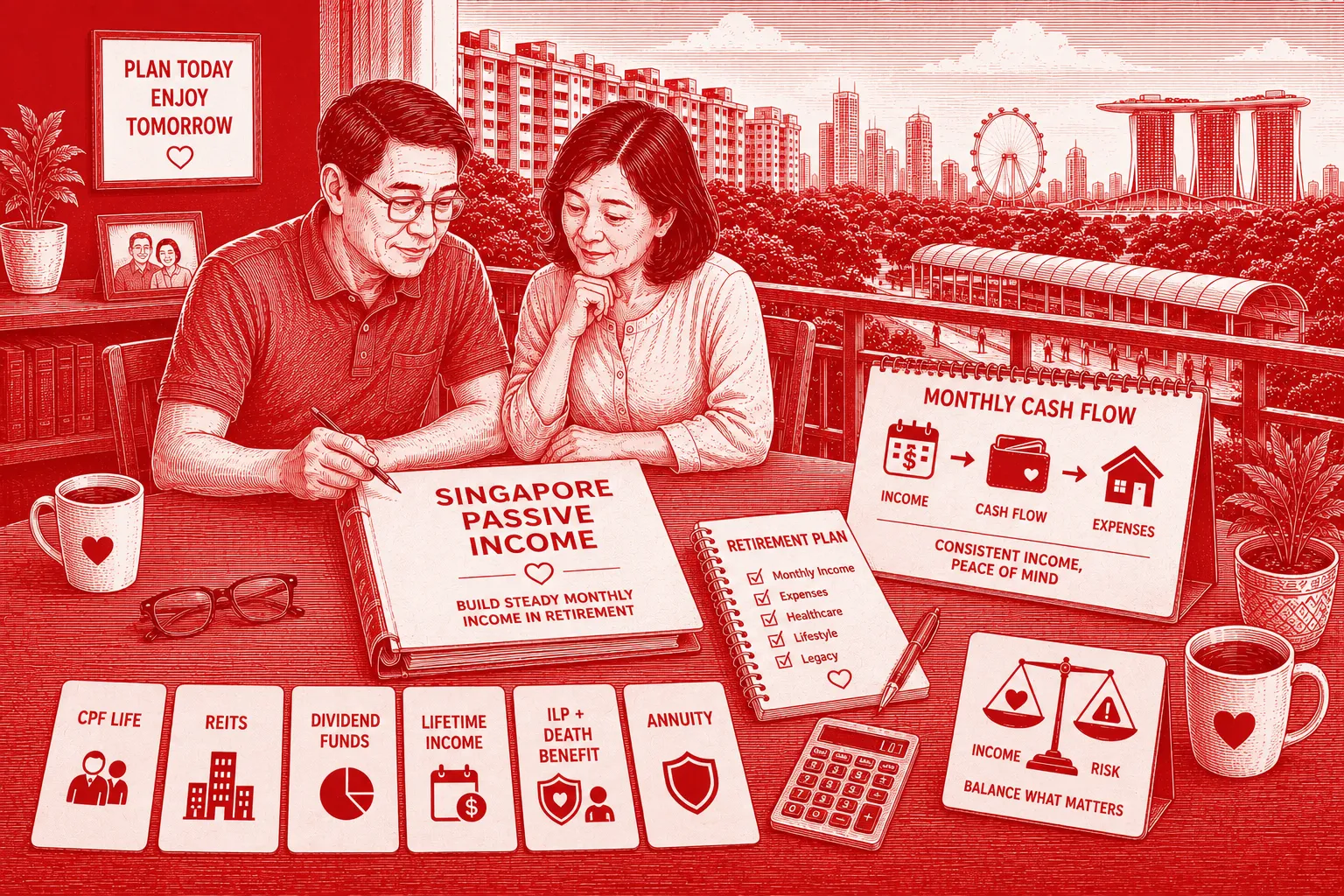
Singapore Passive Income During Retirement: What Actually Works for Ordinary Singaporeans?
Many Singaporeans want to generate passive income in retirement. The idea is simple: after decades of work, you want regular cash flow without having to actively trade, monitor markets every day, or keep worrying about where next month’s income will come from.
But Singapore passive income instruments during retirement should not be confused with “get rich” income. For retirees, the goal is usually stability, simplicity, and cash flow. A good retirement income source should help cover food, utilities, healthcare, insurance, family needs, and lifestyle expenses without causing unnecessary stress.
This article explains common Singapore passive income options for ordinary retirees, including CPF LIFE, life insurance lifetime income plans, private annuity plans, dividend stocks, REITs, dividend-based unit trusts, and investment-linked plans with death benefit features. The aim is not to promote one product as the best, but to help you understand the trade-offs clearly.
Why Retirees Prefer Passive Income
Passive income appeals to retirees because it simplifies cash flow. When you are younger, you may be willing to monitor investments actively, rebalance portfolios, read market news, and decide when to buy or sell. As you grow older, that may become less attractive.
This is why monthly income instruments can feel more suitable in retirement. They reduce the need to constantly decide what to sell, when to sell, and how much to sell. Instead of relying only on capital appreciation, a retiree may prefer income sources that send regular payouts into a bank account.
Growth instruments such as broad-market ETFs can still be useful. They may provide diversification and long-term capital appreciation. But they usually do not solve the monthly income problem directly because the retiree may need to sell units regularly to create cash flow.
This does not mean passive income is automatically safer. A product can pay a monthly income while the capital value falls. The point is that Singapore passive income can make retirement cash flow easier to manage, but the retiree must still understand the risks they are taking.
What Makes a Good Singapore Passive Income Instrument?
A good Singapore passive income instrument should provide regular cash flow in a way the retiree can understand. The payout should be reasonably stable, the risks should be clear, and the retiree should know where the money is coming from.
This question matters: is the payout coming from investment income, capital, non-guaranteed bonuses, fund distributions, or a policy structure? Not all payouts are true income. A product may pay a high monthly distribution, but if part of the payout comes from capital, the fund value may decline over time.
A good retirement income instrument should also match the retiree’s needs. Money needed for essential expenses should usually come from more predictable sources. Money meant for lifestyle expenses may be able to take more investment risk. Money intended for legacy planning may warrant a different structure, such as an insurance product with a death benefit.
This is why the best Singapore passive income option is not always the one with the highest payout. A lower but more reliable income source may be better for essential spending, while a higher but more variable income source may suit only retirees with other stable income.
CPF LIFE as the Foundation
CPF LIFE is often the starting point for retirement income in Singapore. It provides monthly payouts for life and helps reduce the risk of outliving your savings. This makes CPF LIFE useful as the base layer of retirement income.
For many retirees, CPF LIFE can support essential expenses because payouts are designed to continue for life. This makes it different from an investment portfolio that may run down if withdrawals are too high or market returns are poor.
However, CPF LIFE may not be enough to cover every retiree’s desired lifestyle. Some retirees may want additional income for travel, family support, healthcare costs, hobbies, or higher living expenses. CPF LIFE is also less flexible once the payout structure is selected.
It is also important to understand that while CPF LIFE provides payouts for life, the monthly payout amount can change. So CPF LIFE should be seen as the foundation, not necessarily the entire retirement income plan. Many retirees may still need other Singapore passive income sources to support a more comfortable retirement.
Life Insurance Lifetime Income Plans
After CPF LIFE, some retirees may look for additional structured income outside CPF. This is where lifetime income insurance plans may come in.
These plans are usually participating policies designed to provide regular retirement income. They may offer a guaranteed income component, together with projected or non-guaranteed bonuses. They can appeal to retirees who prefer structure, discipline, and some level of certainty.
In this way, a lifetime income plan may solve part of CPF LIFE’s limitation by providing another stream of regular cash flow. Some plans may also include a death benefit or residual value, which may be meaningful for retirees who want income and some legacy value.
The trade-off is that the payout percentage may be modest. In many cases, the guaranteed portion may be relatively low, while the higher illustrated income depends on non-guaranteed bonuses. A lifetime income plan can be useful, but retirees should separate guaranteed income from projected income.
Private Annuity Plans
If a retiree wants a higher monthly payout than some lifetime income products, private annuity plans may be another option to consider. These plans can provide regular income outside CPF LIFE and may appeal to retirees who want additional structured cash flow.
Compared with some lifetime income plans, private annuity plans may offer a higher monthly payout. This can be attractive for retirees who want a higher income during a specific period of retirement.
However, the trade-off is that some private annuity plans may not pay for life. Many are structured to pay income for a fixed period, such as 20 or 30 years, depending on the product terms. This may improve monthly income, but it may also introduce longevity risk if the retiree outlives the payout period.
Private annuity plans may suit retirees who value predictable income over a planned period. But they should be compared with CPF LIFE, lifetime income plans, cash needs, inflation concerns, and other Singapore passive income options before committing.
Dividend Stocks and REITs
Some retirees may be dissatisfied with the lower payouts from more structured income products. They may then look at dividend stocks and REITs for better return potential.
Dividend stocks and REITs can provide passive income in Singapore. You own shares in companies or REITs, and you may receive dividends if the business or trust pays them. REITs are especially familiar to many Singapore investors because they are commonly associated with property income and regular distributions.
This may solve one limitation of structured income products: the income potential may be higher. There is also the possibility of capital appreciation if the underlying business or REIT performs well over time.
But dividend stocks and REITs are not risk-free. Dividends are not guaranteed, share prices can fall, and REITs may be affected by interest rates, refinancing costs, occupancy rates, rental reversions, and property cycles. Income may also be quarterly, semi-annual, or irregular, which may not align with monthly spending needs.
Dividend-Based Unit Trusts
For retirees who like the idea of dividend stocks and REITs but do not want to manage individual counters, dividend-based unit trusts may seem like the next natural step.
Dividend-based unit trusts are popular because they appear to offer an easy Singapore passive income solution. A retiree invests a lump sum, the fund is professionally managed, and distributions may be paid regularly. This can feel convenient for someone who does not want to choose individual stocks.
In this way, dividend-based unit trusts may address two problems associated with direct dividend stocks and REITs. The retiree does not need to monitor individual holdings as closely, and some funds may provide monthly or more regular distributions for retirement budgeting.
However, distributions are not guaranteed. If distributions exceed sustainable returns, the fund’s net asset value may decline over time. This matters during retirement and also at death, because beneficiaries may receive less than the original investment amount if the fund value has fallen significantly.
ILP with Unit Trust Dividend Portfolio and Death Benefit
For retirees who like the monthly income potential of dividend-based unit trusts but are concerned about what beneficiaries may receive if the fund value falls, an investment-linked plan with a dividend portfolio and death benefit feature may be another structure to consider.
Some investment-linked or insurance-linked investment plans can hold dividend-focused portfolios. These plans may support an income-style portfolio or regular withdrawals, while also providing a death benefit based on policy terms. For example, some policies may provide a death benefit based on the account value or a percentage of relevant premiums paid, such as 101%, depending on the product wording.
This should not be described as “capital guaranteed upon death”. A safer way to explain it is that the policy may include a death benefit feature or a minimum death benefit structure, depending on the policy terms. This may address one concern of a pure dividend unit trust portfolio, especially if the retiree wants some legacy value for beneficiaries.
The trade-off is cost and complexity. ILPs usually have insurance charges, policy fees, fund management charges, and investment risk. They are not automatically bad, but neither are they automatically good. They may make sense for a retiree in the late 60s or early 70s who already has enough income for daily needs, is using spare funds, wants dividend-oriented investment exposure, and values the death benefit feature.
How to Compare Singapore Passive Income Options
When comparing Singapore passive income options, do not start with the payout rate. Start with the nature of the payout. Is it guaranteed, projected, or variable? Can it be reduced? Is it coming from investment income, capital, bonuses, or regular withdrawals?
Next, look at capital risk. Will the capital value fluctuate? Can the value fall permanently? Is the retiree comfortable with the account or fund value declining? A product that pays a monthly income but steadily reduces capital may still be unsuitable if the retiree expects the capital to remain intact.
Fees and liquidity also matter. A product with high charges must provide enough value to justify the cost. A product with limited liquidity may be unsuitable for emergency funds. Retirees should also consider whether there is a death benefit or legacy value, and whether withdrawals may reduce that benefit.
The practical way to compare options is to match them to the purpose. Essential expenses should usually be supported by more predictable income sources. Lifestyle expenses can be supported by more variable income sources. Legacy goals may justify insurance structures or assets that can pass to beneficiaries.
Matching Income Sources to Retirement Needs
Not all retirement expenses should be funded the same way. Essential expenses such as food, utilities, basic healthcare, transport, and insurance premiums should ideally be supported by more predictable income sources. CPF LIFE, guaranteed income components from life insurance income plans, and a cash buffer may be more suitable for this layer. These sources may not offer the highest returns, but they can help build confidence for basic spending.
Flexible lifestyle expenses can tolerate more variation. This may include travel, hobbies, gifts, or discretionary spending. Dividend stocks, REITs, dividend-based unit trusts, and investment-linked dividend portfolios may fit better here because income and capital value can fluctuate.
Legacy planning is another layer. Some retirees want to leave money to beneficiaries. In that case, life insurance plans, ILPs with death benefit features, or assets that can be transferred to loved ones may be relevant. The important principle is simple: use predictable sources for needs and more variable sources for wants.
Common Passive Income Mistakes in Retirement
One common mistake is chasing the highest payout percentage. A high payout may look attractive, but it may come from capital, non-guaranteed bonuses, or higher-risk assets.
Another mistake is assuming distributions are guaranteed. Unit trust distributions, stock dividends, and REIT distributions can change. Even projected bonuses from participating policies are not guaranteed until declared.
A third mistake is ignoring capital decline. Some income funds continue paying distributions even while net asset value falls. This may not be wrong if the retiree understands it, but it is dangerous if the retiree mistakes capital withdrawal for investment income.
A fourth mistake is treating all ILPs as either good or bad. Both extremes are too simplistic. ILPs have higher costs and investment risks, but some may offer a death benefit structure that is valuable to certain retirees. The real question is whether the value justifies the cost and complexity.
Conclusion: Passive Income Must Be Sustainable
Singapore passive income during retirement should be practical, not exciting. The best income source is not always the one with the highest payout. The better income source is the one that fits your cash flow needs, risk tolerance, capital needs, and legacy goals.
CPF LIFE can provide the foundation. Life insurance lifetime income plans may offer structure and some guaranteed income, but payouts may be modest. Private annuity plans may offer higher income over a fixed period, but they may not always provide lifetime payouts.
Dividend stocks and REITs can offer return potential, but income may fluctuate and may not be monthly. Dividend-based unit trusts may provide more regular distributions, but the fund value may fall over time. Investment-linked plans have higher costs, but they may have a role for retirees who want investment exposure alongside a death benefit.
The real purpose of passive income in retirement is not to maximise yield at all costs. It is to create a cash flow structure that you can live with, understand, and sustain as you grow older. Do not chase passive income without understanding what you are giving up.
Frequently Asked Questions
Not always. Some income sources, such as CPF LIFE, require little ongoing management, while others, such as dividend stocks, REITs or rental properties, may require regular monitoring, maintenance or investment decisions.
The amount depends on your expected retirement expenses, lifestyle and other income sources. A good starting point is to estimate your monthly retirement budget and determine how much of it can be covered by reliable passive income.
Yes. CPF LIFE provides eligible Singaporeans with lifelong monthly payouts after retirement and is one of the most stable sources of passive income available in Singapore.
Income sources such as CPF LIFE, annuity plans and high-quality fixed-income investments are generally more predictable than dividend stocks or REITs, whose payouts may fluctuate depending on market conditions and business performance.
Generally, no. Depending on a single source of passive income may increase your financial risk. Many retirees combine CPF LIFE with investments, savings or annuity plans to diversify their retirement income.
It depends on the source. CPF LIFE provides lifelong monthly payouts, while the amount is not guaranteed. Some annuity plans offer guaranteed benefits. Dividend stocks, REITs and investment funds generally do not guarantee future income, and distributions may increase or decrease over time.
Yes. Building passive income often starts with saving and investing consistently over many years. The earlier you begin, the more time your investments have to grow and generate future income.
Common mistakes include:
- Chasing high yields without understanding the risks
- Depending on a single income source
- Ignoring inflation
- Underestimating investment fees
- Expecting passive income to be completely risk-free
During retirement, reliability usually matters more than chasing the highest passive income. A higher projected yield often comes with higher investment risk or less predictable income. During retirement, many Singaporeans prioritise stable and sustainable cash flow over maximising returns. The most suitable passive income strategy is one that provides reliable income while matching your financial goals, risk tolerance and lifestyle.
It depends on the source of income. Some passive income sources provide fixed payouts, while others may have the potential to grow over time. When planning for retirement, consider how inflation could reduce your purchasing power and whether your overall passive income strategy includes assets that may help offset rising living costs.